01
Every connector depends on its contact points
An electrical plug contact is only as good as its contact points. Two metal surfaces never touch over their full area, only at tiny spots, and the entire current has to pass through these constrictions. How many contact points there are, how much force they apply and how constant that force remains over tolerances, temperature and service life determines contact resistance, temperature rise and wear.
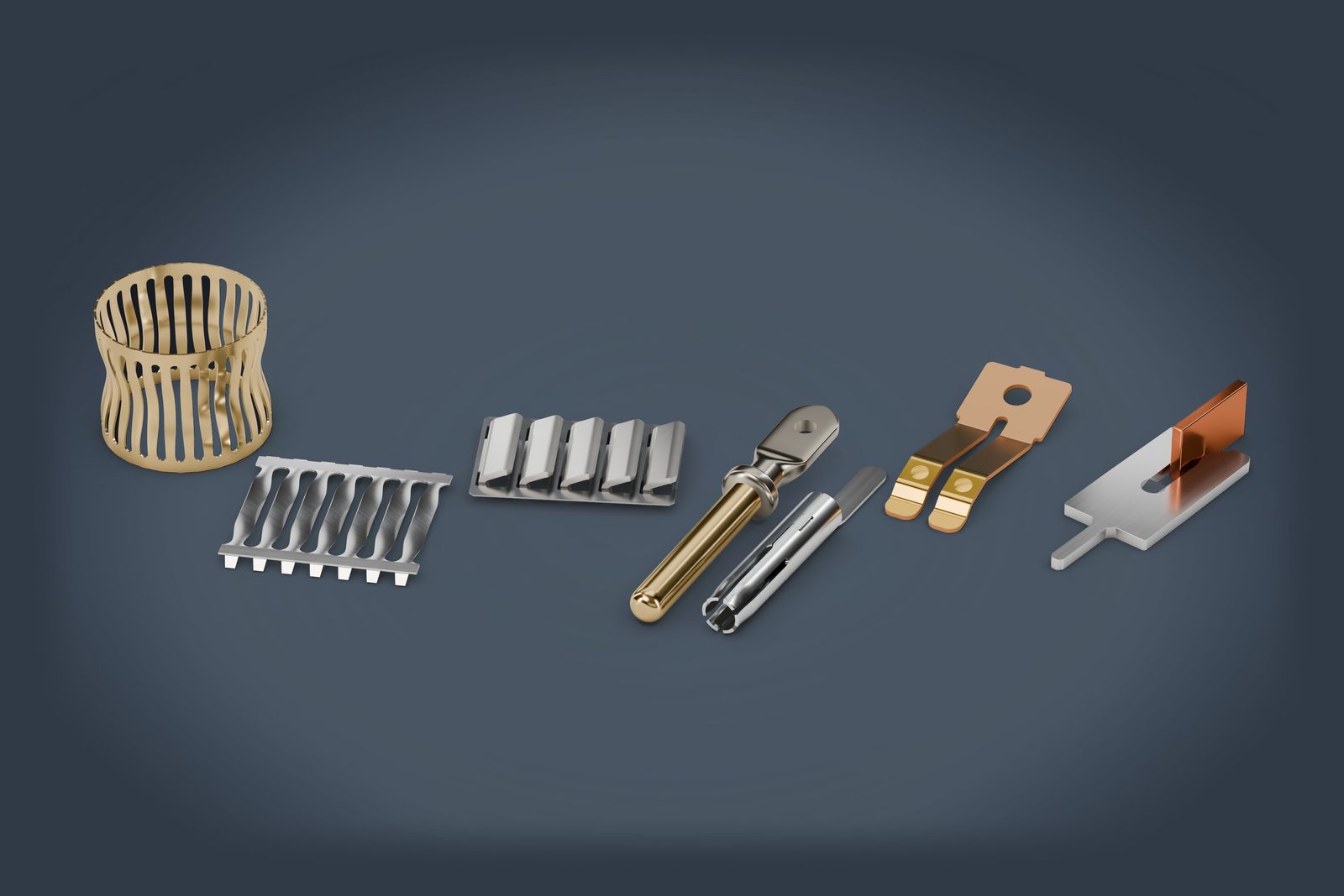
The common contact types solve this in different ways. Lamella contacts share the current across many parallel webs. Slotted sockets work with a few strong spring fingers. Canted coil springs use the inclined coils of a wire spring. Hyperboloid contacts enclose the pin with wires stretched at an angle. Stamped cantilever contacts apply force through one or more spring arms. Fork contacts clamp the mating part between two spring arms. This comparison shows the tendencies and helps you shortlist.
Few contact spots
The current is squeezed through a few points.
Many parallel contact spots
Each contact spot carries only part of the current.
02
Lamella contacts: what sets them apart from other contact types
A lamella contact is a stamped and formed contact band with many parallel webs (louvers). It sits in a groove in the socket or on the pin and bridges the gap between the two with spring force. Each web (called a bridge in the datasheets) forms its own contact point and carries only part of the current. Contact lamella, lamella contact and louvered contact band all describe the same principle.
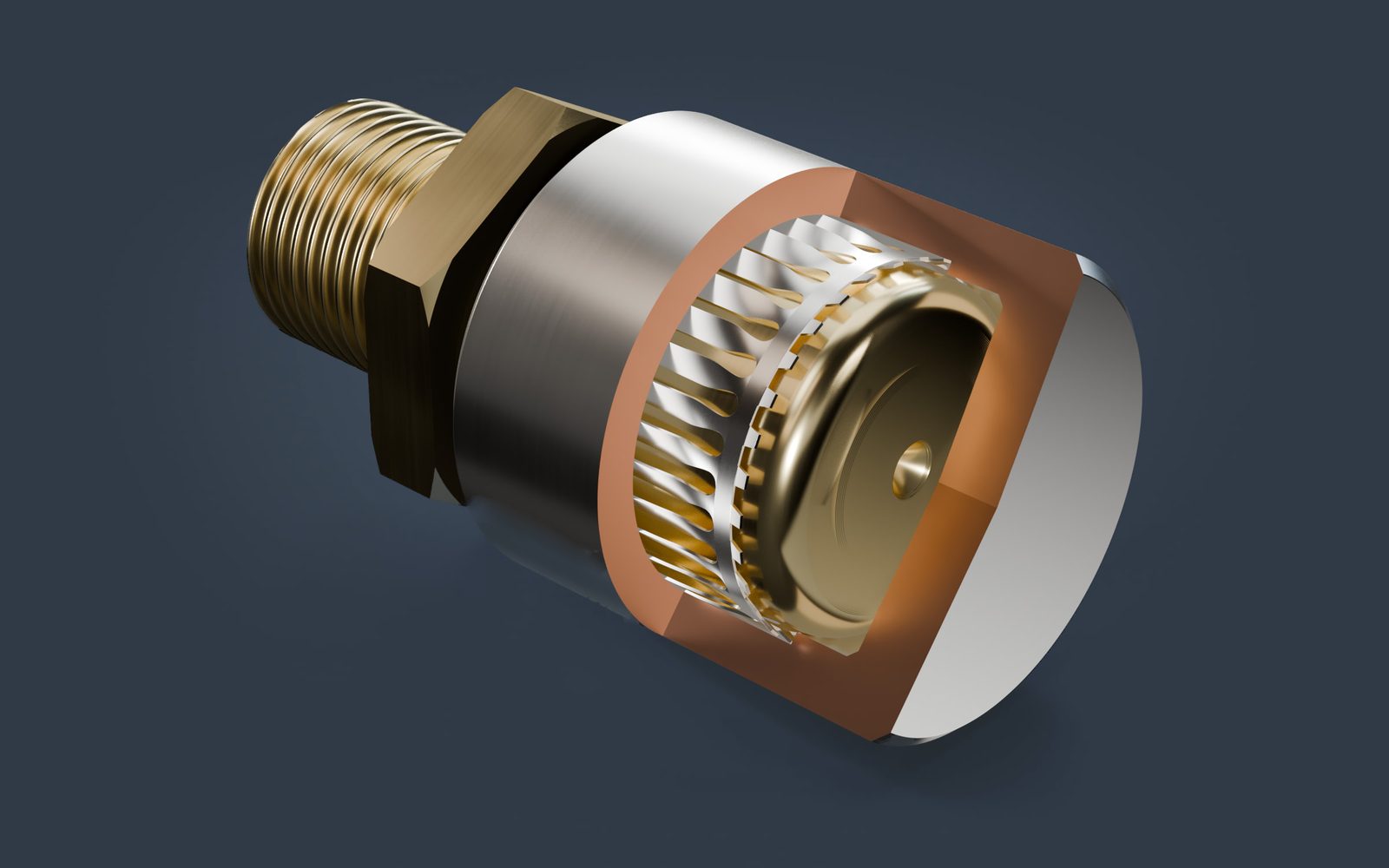
Compared with a slotted socket or a stamped spring arm, a lamella contact has far more contact points with less force per point. Because each web adapts individually to the mating surface, lamella contacts compensate for form and position tolerances. During mating, the web edges push contamination aside. The datasheet of our torsion spring contact band also describes this self-cleaning effect.
How current and resistance scale from the values per web is explained on the contact lamellae page.
Equivalent circuit
Socket and pin are connected in parallel through n webs.
0.4 mΩ 10 0.04 mΩ
Worked example from the datasheet
Torsion spring contact band 17.5 mm, 0.2 mm material thickness, against silver-plated copper mating contacts: 0.4 mΩ per web, ten webs give a calculated 0.04 mΩ.
03
Eight contact types compared
| Criterion | Current rating | Mating cycles | Insertion force | Installation space | Cost |
|---|---|---|---|---|---|
| Leaf spring contact band | medium to high | high | low to medium | very compact | medium |
| Torsion spring contact band | very high | high | medium | medium | medium |
| High-current contact band (hybrid) | very high | high, also with movement | low to medium | medium, 1.5–2.0 mm radial | medium to high |
| Slotted socket | low to medium | medium | medium to high | compact | low |
| Canted coil spring | high | high | low | medium | medium to high |
| Hyperboloid contact | high | very high | low | medium | high |
| Stamped cantilever contact | low to medium | low to high, depending on finish | medium to high | flat and compact | low in volume production |
| Fork contact | low to medium | low to high, depending on finish | medium to high | flat, fork in the strip plane | low in volume production |
Qualitative tendencies at comparable diameter and finish, not ratings. Current rating and mating cycles depend strongly on finish, contact force, mating contact, heat dissipation and installation, and must be verified in the application.
Leaf spring contact band
The webs are loaded in bending and arch towards the mating surface.
Torsion spring contact band
Torsion of the webs creates the contact force, and the current path is short.
High-current contact band
A spring-steel carrier creates the force, riveted copper contact pieces carry the current.
Slotted socket
A few strong spring fingers grip the pin.
Canted coil spring
Inclined coils keep the force almost constant over a long spring travel.
Hyperboloid contact
Inclined, tensioned wires wrap the pin in line contact.
Stamped cantilever contact
A spring arm applies the force, contact and spring are one part.
Key
- current path
- contact spot
- spring material
- copper as conductor
- spring steel
- socket, pin or mating contact
04
How to read the criteria
Current rating is not a fixed property of a contact but the result of contact resistance, heat dissipation and permissible temperature rise. The same lamella carries more current in a solid copper conductor than in a thin brass part. That is why ACA datasheets state the test conditions and require verification in the application.
The number of mating cycles is usually limited by the finish, not by the spring. Gold and passivated silver tolerate many matings, tin only a few. Contact force and lubrication also play a part.
Insertion force can be estimated as follows: insertion force ≈ friction coefficient × contact normal force per contact point × number of contact points. Our datasheets give an approximate friction coefficient of 0.3 for the torsion spring contact band and 0.4 to 0.6 for the high-current contact band. A suitable contact lubricant reduces insertion force.
Installation space mainly means radial installation height and groove width. Cost covers not only the contact element but also the machining of pin and socket, assembly and, for stamped parts, tooling.
05
Leaf spring contact band: compact and versatile
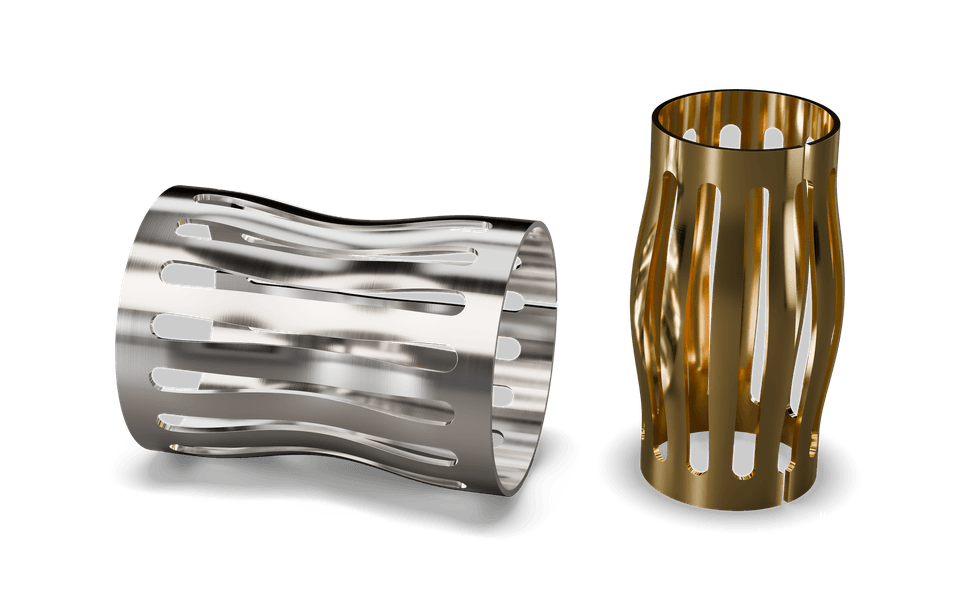
In the leaf spring contact band, the webs are loaded in bending: each web bows towards the mating surface like a small leaf spring. The band is pre-rounded to the mating diameter and fitted into a groove on the pin or a recess in the socket, where it is held captive. A simple turned part is all that is needed to hold it. Rolled into a basket, the socket version is also called a contact basket.
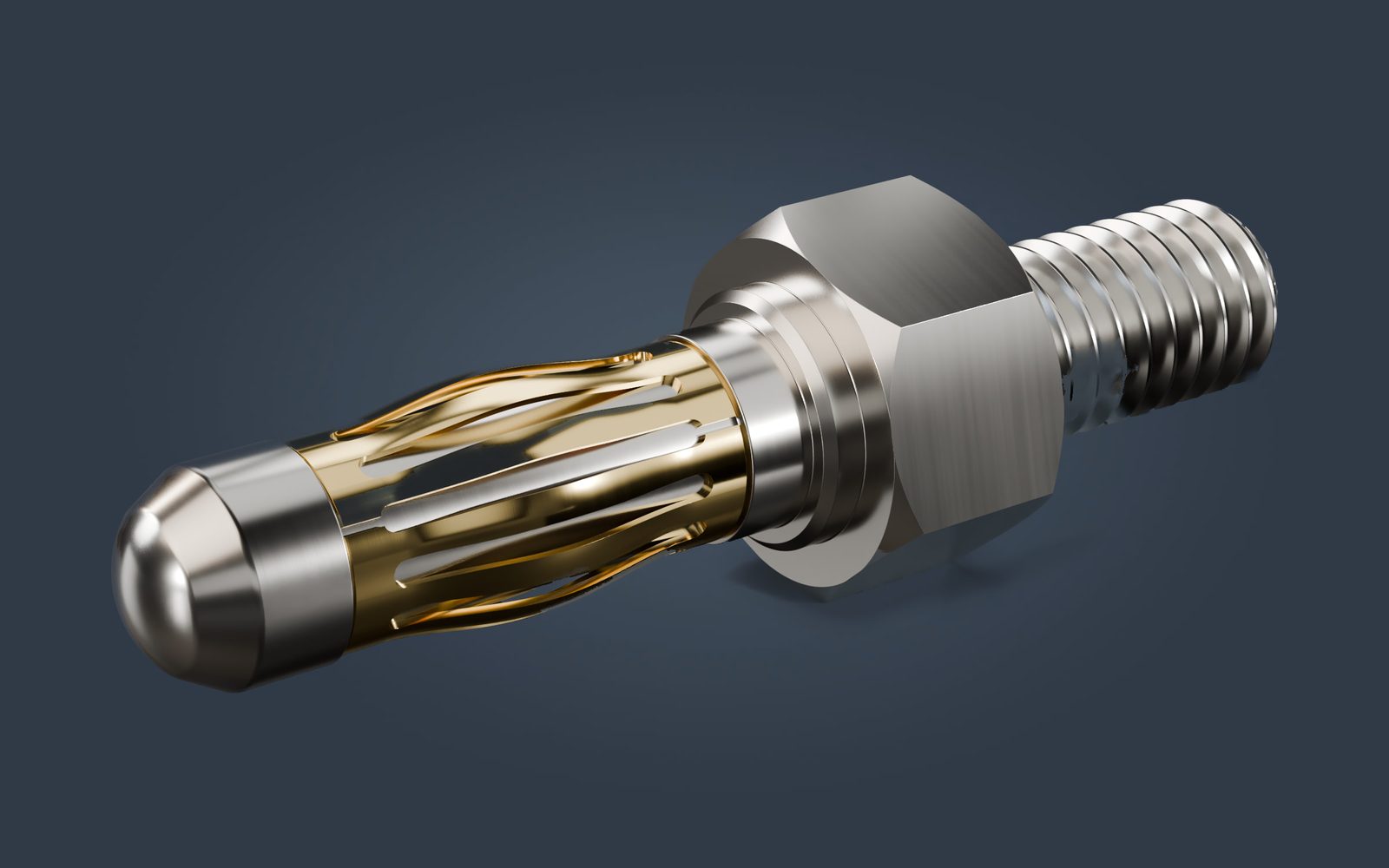
The leaf spring contact band suits both power and signal transmission, and above all small mating diameters. Leaf spring contact band
- Mating diameters from 1.5 mm, standard sizes from 2 to 8 mm for pins and from 1.5 to 16 mm for sockets
- Typical in measuring and test equipment, medical technology, photovoltaics and machine connectors
06
Torsion spring contact band: high currents, wide working range
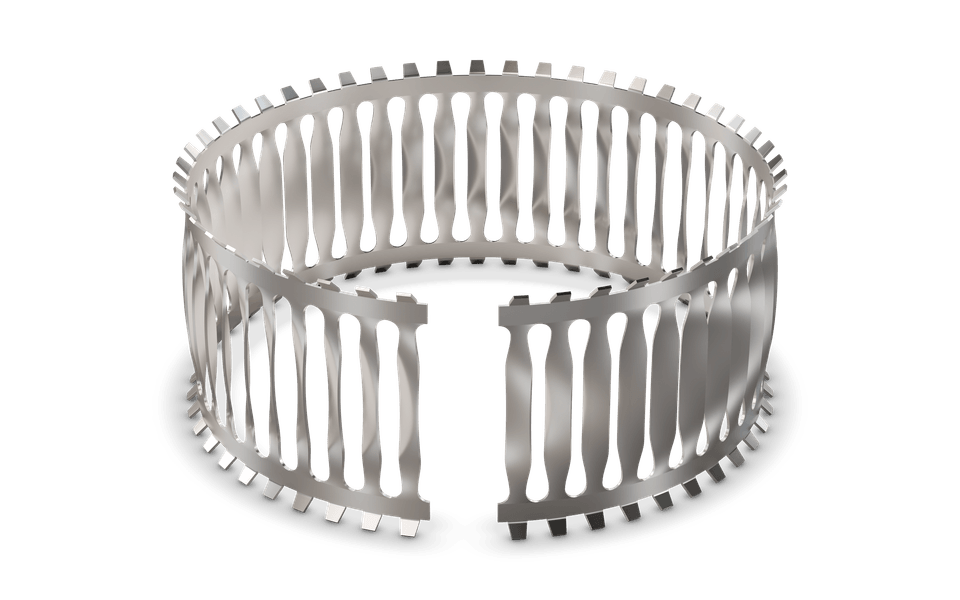
In the torsion spring contact band, contact force comes from twisting the webs. Compared with a leaf spring, the spring characteristic is flatter, the working range is larger, and current takes the shortest path from pin to socket. Side legs with a selectable angle hold the band in its groove.
The torsion spring contact band is normally used in larger connectors for power transmission, mostly as a socket contact. There it sits protected from external mechanical influences. Torsion spring contact band
- Usually from 8 mm mating diameter, designed as a socket contact from 20 mm
- For electric vehicles, charging infrastructure, drive technology and industrial connectors
07
High-current contact band: force and current separated
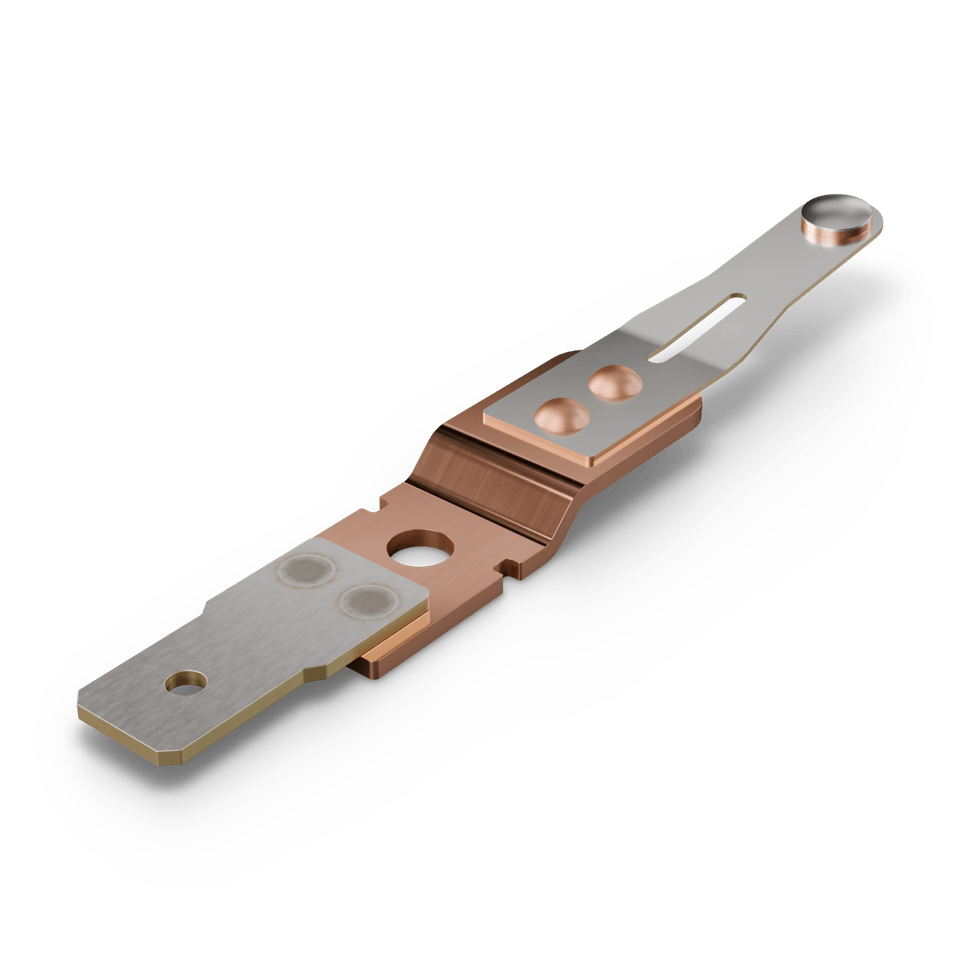
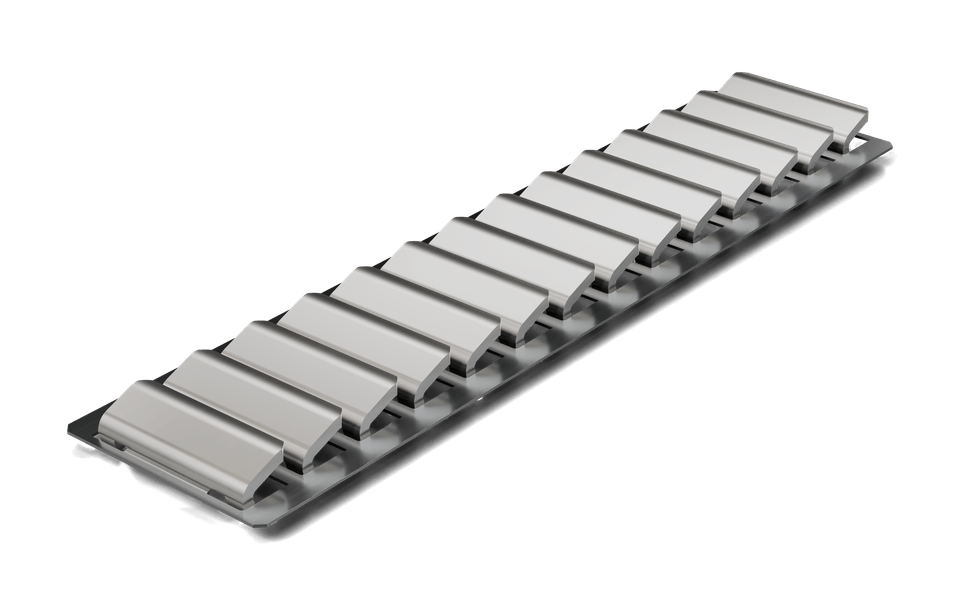
The high-current contact band is a hybrid. A carrier strip of stainless spring steel generates the contact force, while riveted contact pieces of silver-plated copper carry the current. Because only low contact forces are needed, the band wears little and also suits dynamic applications and moving parts. The copper contact pieces absorb a lot of heat, which increases the short-time withstand current.
The band sits in a groove in the socket or, for flat contact arrangements, in an undercut groove. High-current contact band
- Contact force approx. 6 N per web at maximum compression to 1.5 mm
- Rated current as a guide value above 40 A per web, to be verified in the application
08
Slotted socket: a few strong fingers
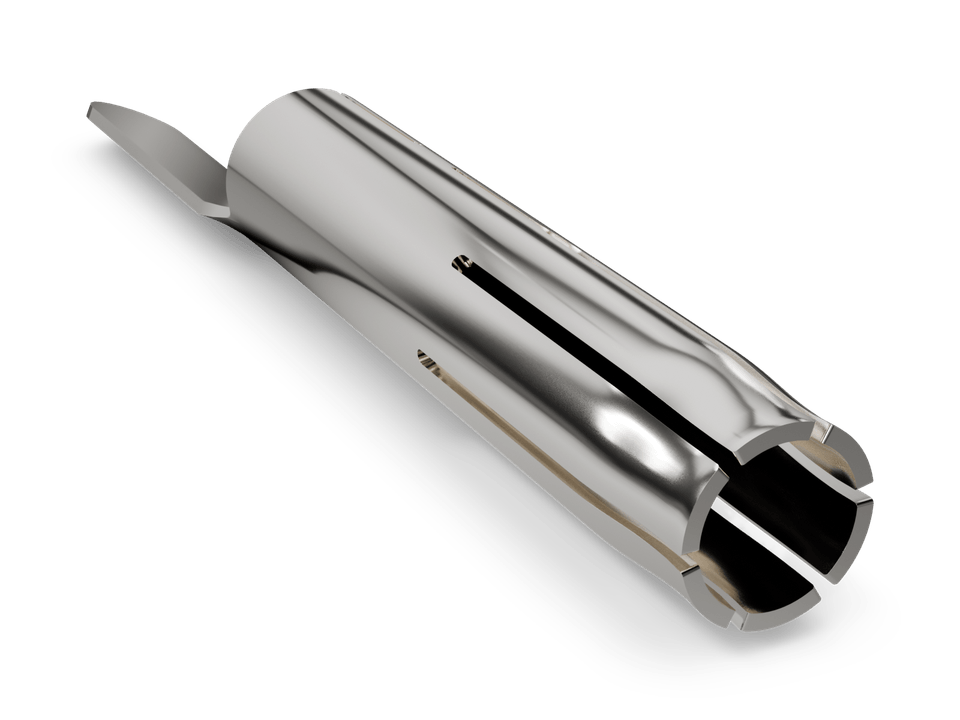
A slotted socket is a sleeve whose wall is divided into several spring fingers by longitudinal slots. The fingers are preloaded inwards and grip the inserted pin. Simple spring baskets with a few wide fingers, fitted into a socket as a separate part, work in a similar way. Both designs use comparatively few contact points with a higher force per point.
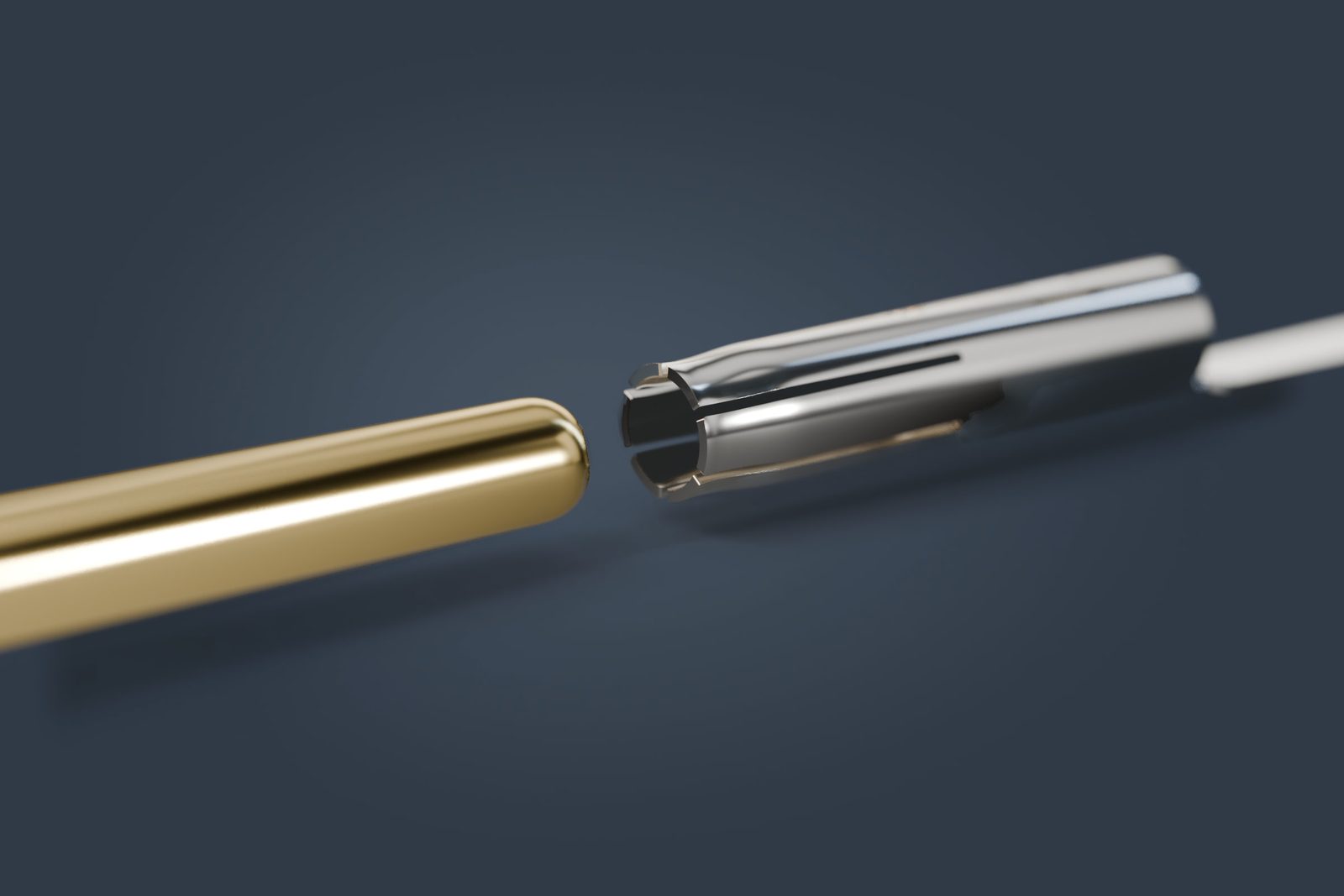
Their strengths are simple construction and low cost. Their limits are current rating and insertion force, which varies with finger force and with the tolerances of pin and socket. For higher currents or tight insertion force requirements, a lamella contact is usually the better choice. ACA makes basket springs and rolled sockets as stamped parts to drawing.
09
Canted coil spring: near-constant force over a wide deflection range
A canted coil spring is a helical wire spring whose coils are inclined to the spring axis. Closed into a ring, it sits in a groove on the pin or in the housing. When it is compressed radially, the coils tilt further. As a result, the force stays almost constant over a wide deflection range, and each coil forms a contact point.
The result is low, even insertion forces and high mating cycles combined with a high current rating. On the other hand, the spring and the groove geometry are more complex than with a stamped contact. Canted coil springs are also used as holding and latching elements and for shielding. ACA does not make canted coil springs. Where low contact forces at high currents are required, the high-current contact band is an alternative that can be produced as a stamped band in many lengths.
Contact force over spring travel
Leaf spring steeper, torsion spring flatter with a larger working range, canted coil spring almost constant over a long travel.
10
Hyperboloid contact: a wire cage for very many mating cycles
A hyperboloid contact is a socket in which straight wires are stretched at an angle to the axis, forming a hyperboloid. The pin is enclosed by all the wires along lines of contact, which gives low insertion forces and a very high number of mating cycles. The socket is complex to make and correspondingly expensive. ACA does not make hyperboloid contacts.
11
Stamped cantilever contact: economical in high volumes
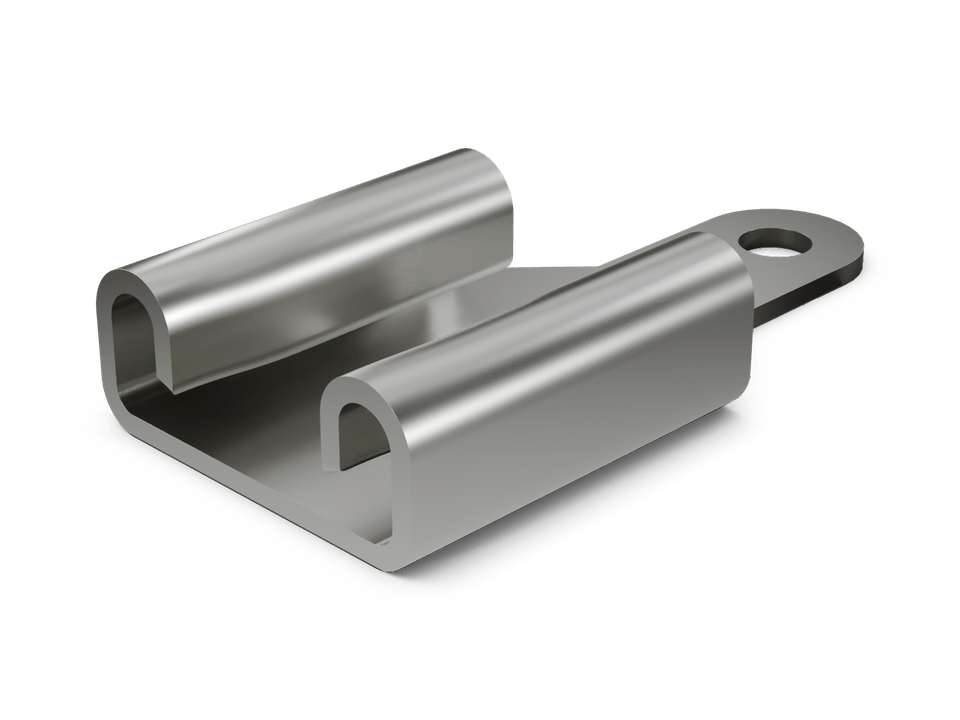
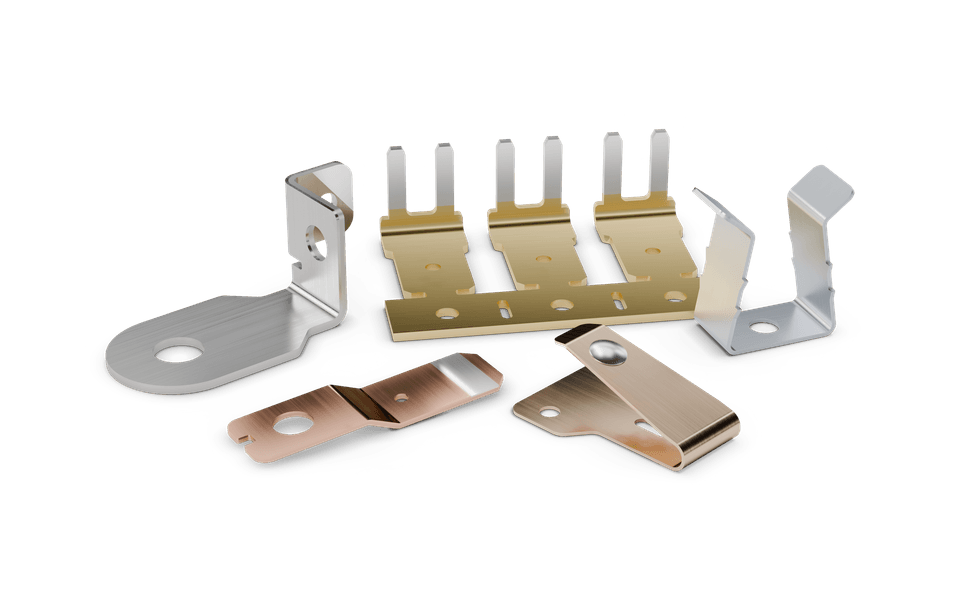
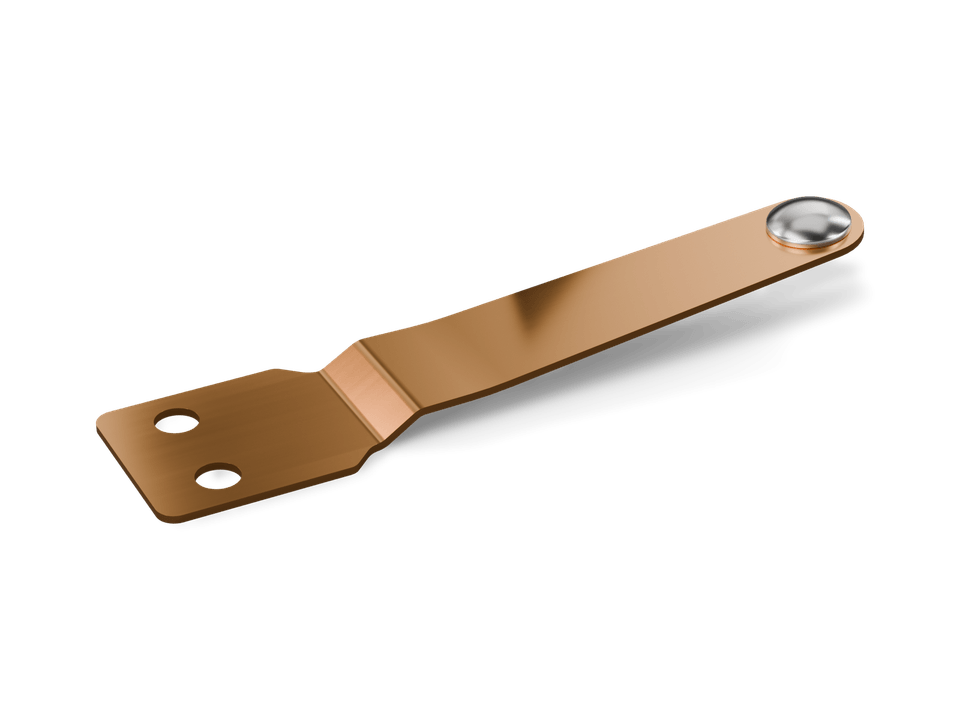
A cantilever (spring-beam) contact is a stamped and bent part in which one or more spring arms provide the contact force, for example in flat receptacles, fork contacts and many socket contacts. Contact and spring are one single part. It is made in a progressive die and can go straight to assembly on the reel.
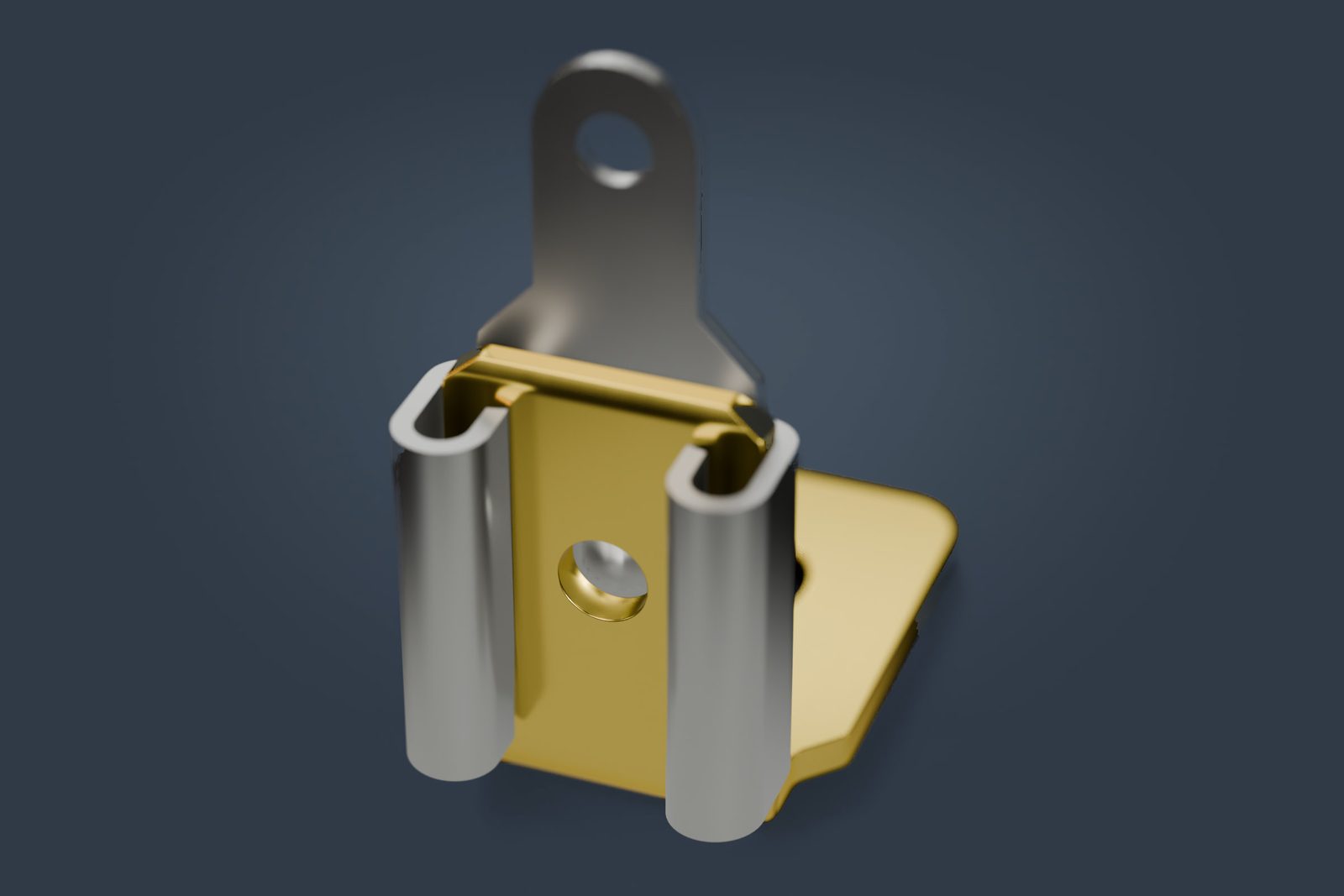
The current rating is limited by the few contact points and the cross-section of the spring arms, and the insertion force is usually higher than with lamellae. The number of mating cycles depends mainly on the finish: tin-plated contacts are designed for a few matings, gold-plated ones for many. In high volumes, the stamped cantilever contact is usually the most economical contact type. ACA makes flat tabs and receptacles, round pin and socket contacts, fork contacts and contact springs to drawing.
12
Fork contact: two spring arms, two contact points
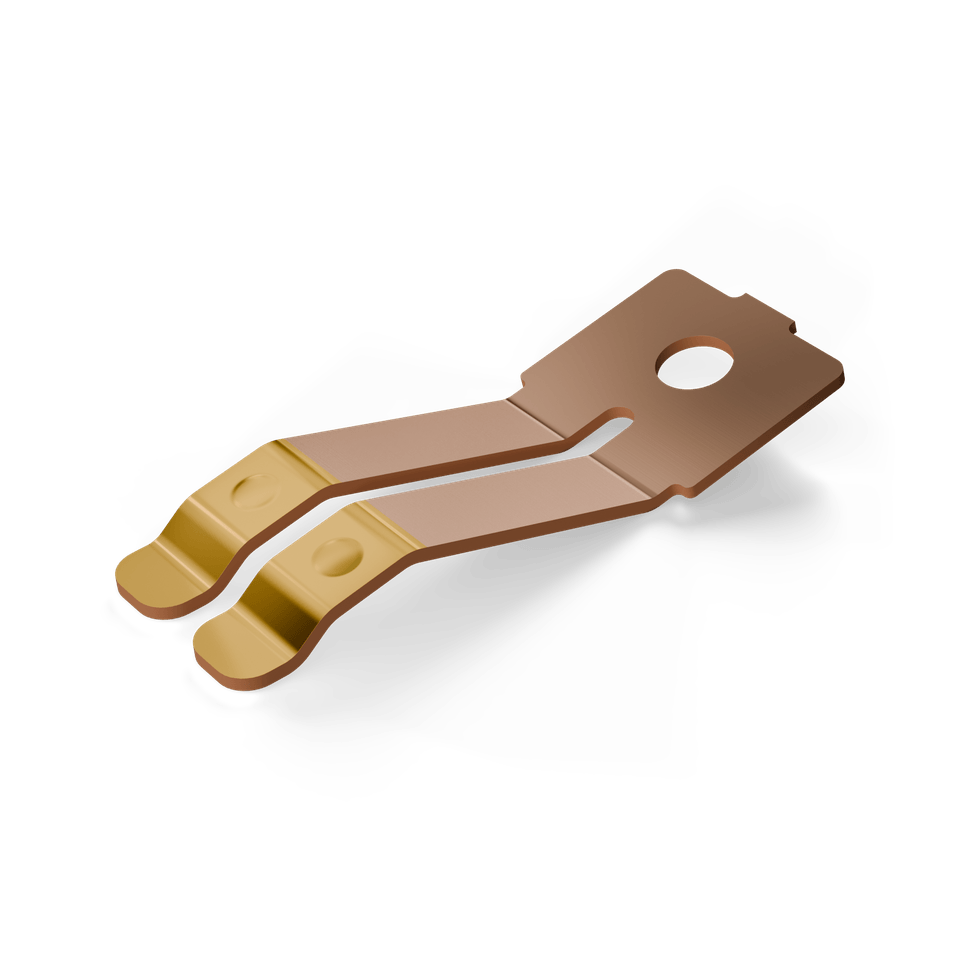
A fork contact is a stamped spring contact with two opposing spring arms that clamp a mating part between them, for example a blade, a pin, a copper bar or the edge of a circuit board. On insertion both arms spring apart, and their preload creates the contact force. Because the arms press from both sides, the lateral forces on the mating part cancel out, and the current flows through two contact points.
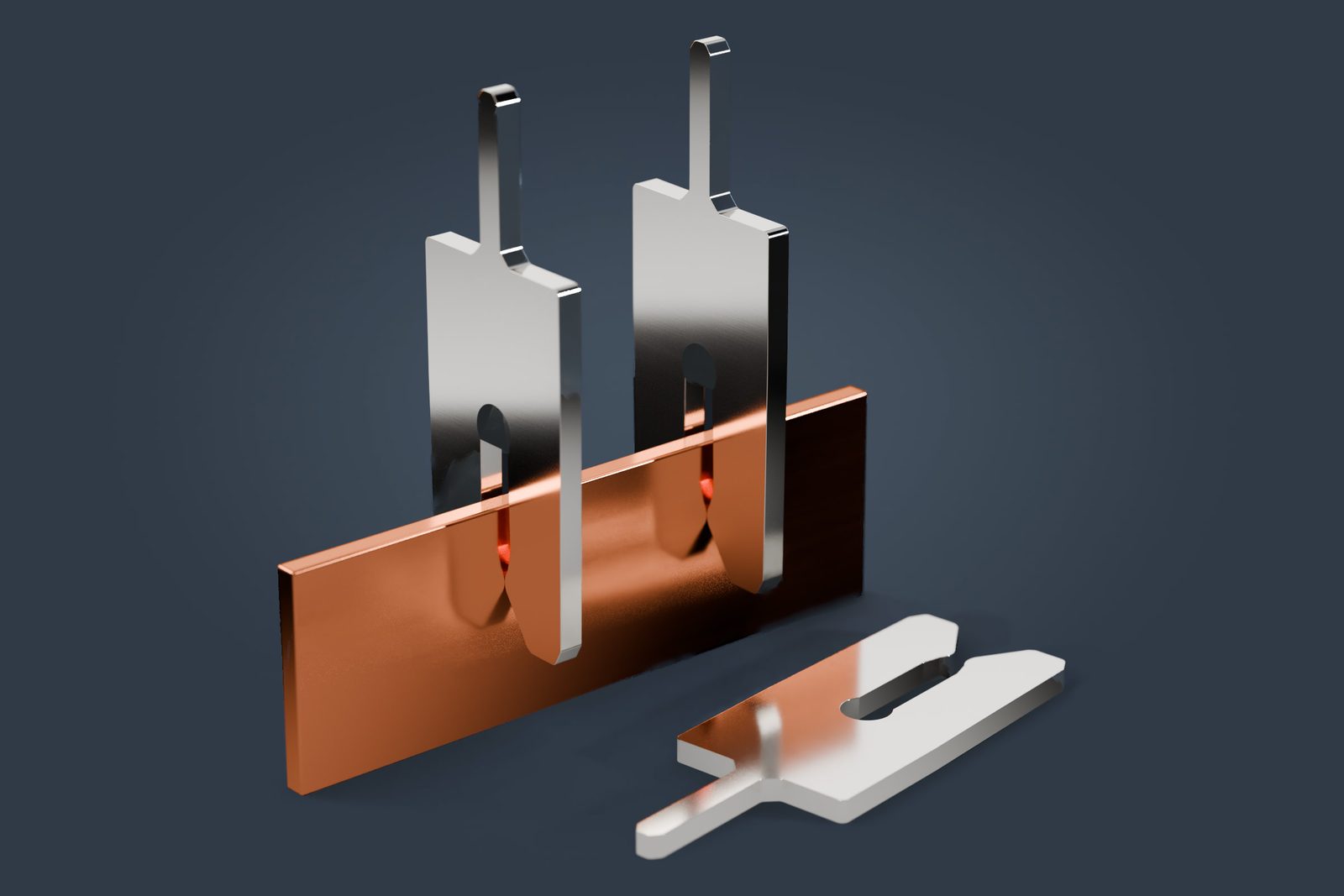
The typical design is the flat stamped fork: the spring arms lie in the strip plane, and their cut edges contact the mating part. Strip thickness, cut quality and the contour of the fork opening therefore determine the contact behaviour. Current rating and mating cycles follow the same rules as for a single spring arm: cross-section and the number of contact points limit the current, and the finish decides the number of matings. ACA Atlas Contacte makes flat stamped fork contacts to drawing in a progressive die. Delivery form and finish follow your specification, and dimensions and currents are available on request. More on the plug contacts page.
13
The three ACA contact bands at a glance
| Criterion | Leaf spring contact band | Torsion spring contact band 17.5 mm | High-current contact band 12 mm |
|---|---|---|---|
| Spring principle | bending of the webs | torsion of the webs | steel spring carrier with riveted copper contacts |
| Base material | beryllium copper | beryllium copper, relaxation-resistant | stainless spring steel and copper |
| Finish | nickel, silver or gold | silver plated, alternatively bare | contact pieces silver plated, 20 µm as standard |
| Mating diameter | from 1.5 mm | usually from 8 mm | large diameters and flat contacts, on request |
| Pitch | on request | 2.5 mm | 3.5 mm |
| Resistance per web | on request | 0.55 / 0.4 / 0.3 mΩ at 0.15 / 0.2 / 0.25 mm material thickness | 0.5 mΩ |
| Temperature range | on request | −40 °C to +180 °C | −40 °C to +150 °C |
| Delivery form | pre-rounded, ready to install | pre-rounded or as a flat strip section | strip piece with a defined number of contacts, or by the metre |
Values from ACA datasheets and installation drawings. Resistances measured against silver-plated copper mating contacts. The current rating depends on the application and must be verified in use.
14
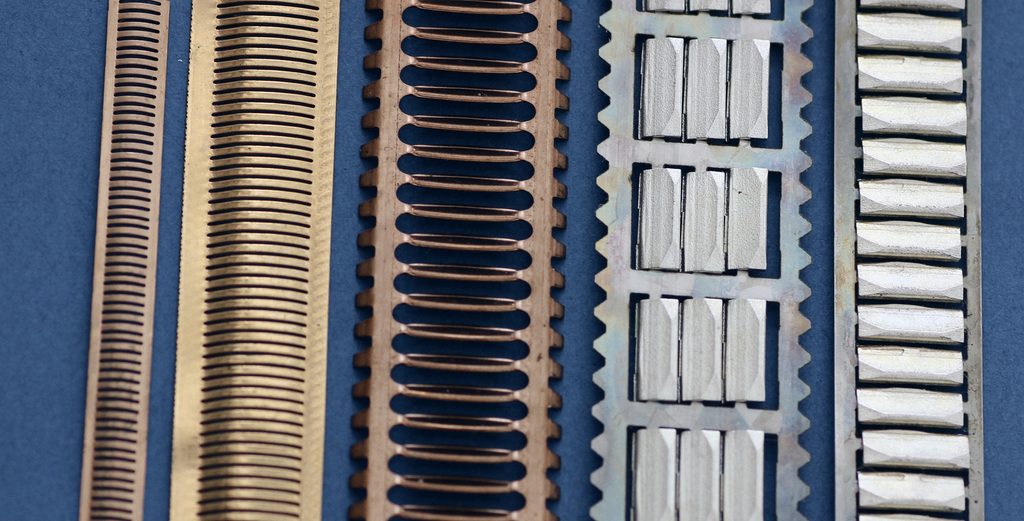
Contact lamellae and stamped contacts from ACA
-
-
-
03
High-current contact band
Stainless spring steel carrier with riveted contact pieces of silver-plated copper
-
-
-