01
Conductivity or spring force: the basic trade-off
A contact material has to do two jobs at once: carry current and provide contact force. The two requirements pull in opposite directions. Pure copper conducts extremely well but hardly acts as a spring. Alloying elements such as tin, beryllium, nickel with silicon, or iron make copper stronger and springier, but lower its electrical conductivity. Every choice of material is therefore a trade-off between current, force, temperature, formability and price.
Conductivity is often stated in percent IACS (International Annealed Copper Standard). 100 % IACS corresponds to 58 MS/m at 20 °C, the conductivity of annealed pure copper. Electrolytic tough pitch copper, Cu-ETP, typically reaches around 100 % IACS and is therefore the benchmark for every other contact material.
The second property is often underestimated in practice: resistance to stress relaxation. A spring that works under preload at elevated temperature loses part of its force over time. As the contact force drops, contact resistance rises, the contact runs hotter and relaxation accelerates. For contacts that stay warm in service, stress relaxation resistance often matters more than conductivity in the as-new condition.
- Cu-ETP: Electrical conductivity very high, Spring properties low
- CuFeP: Electrical conductivity high, Spring properties medium
- CuNiSi: Electrical conductivity medium to high, Spring properties high
- CuBe: Electrical conductivity medium, Spring properties very high
- CuSn: Electrical conductivity low, Spring properties high
- CuZn: Electrical conductivity medium, Spring properties low to medium
- Spring steel (stainless, carbon): Electrical conductivity very low, Spring properties very high
02
Contact materials compared
| Criterion | Conductivity | Spring properties | Stress relaxation resistance | Bendability | Cost level |
|---|---|---|---|---|---|
| Copper (Cu-ETP) | very high, typically around 100 % IACS | low | low | very good | medium |
| Copper-iron-phosphorus (CuFeP) | high | medium | medium | good | low to medium |
| Copper-nickel-silicon (CuNiSi) | medium to high | high | very good | medium to good | medium to high |
| Beryllium copper (CuBe) | medium | very high | very good | good before age hardening | high |
| Phosphor bronze (CuSn) | low | high | medium | good | medium |
| Brass (CuZn) | medium | low to medium | low | very good | low |
| Stainless spring steel | very low | very high | very good | medium | medium |
| Carbon spring steel | very low | very high | good | limited when hardened | low |
ACA Atlas Contacte processes all eight materials in this table, stainless spring steel for example as 1.4310 and carbon spring steel as C75S. The ranking is qualitative and for orientation only, not property values. Actual values depend on alloy, temper and mill. The material standard and the strip supplier's datasheet are binding.
03
Copper and copper alloys for contacts
-
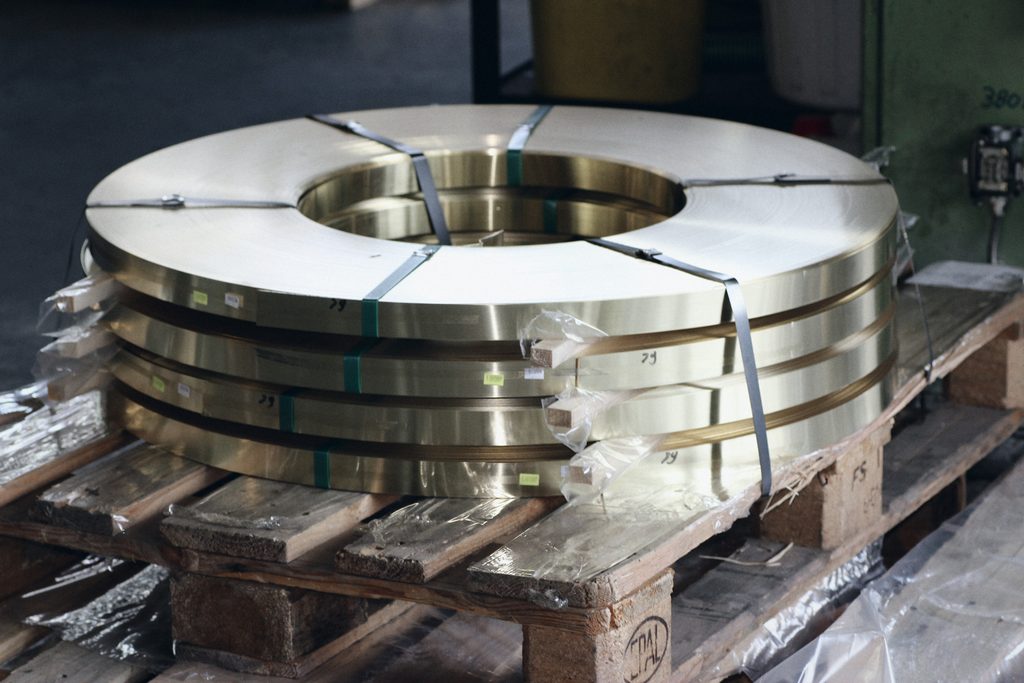
Copper (Cu-ETP)
CW004A
Cu-ETP is the default material when carrying current is the main task and little spring force is needed: contact pieces, connection parts and current paths. Copper bends very well but quickly loses force under heat and preload. Where spring force is needed, a second material provides it. In the ACA high-current contact band, contact pieces of high-conductivity copper are riveted onto a carrier strip of stainless spring steel.
-
Copper-iron-phosphorus (CuFeP)
e.g. CuFe2P, CW107C
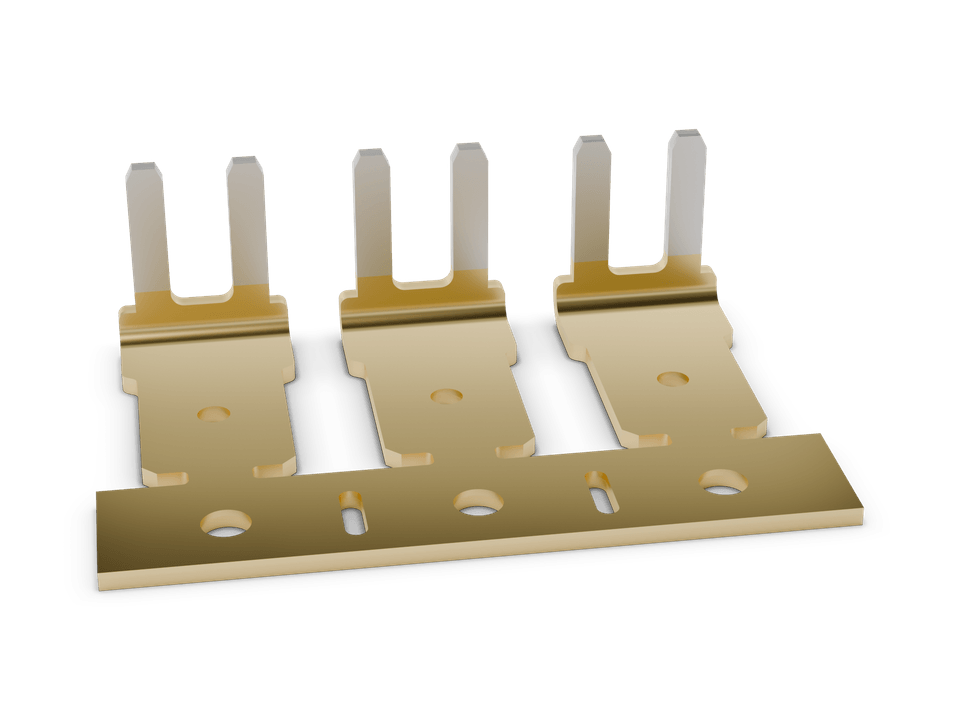
CuFeP sits between copper and the classic spring bronzes: considerably stronger than copper while keeping high conductivity. Typical uses are connectors, terminal tabs and parts with a moderate spring function that carry a lot of current and do not run hot continuously. It forms well and plates well.
-
Copper-nickel-silicon (CuNiSi)
e.g. CuNi2Si, CW111C
CuNiSi alloys are precipitation-hardening. They combine high strength with good conductivity and very good stress relaxation resistance. That makes them suitable for contact springs and plug contacts that stay warm in service, for example in power electronics or charging connectors. CuNiSi is also the obvious beryllium-free alternative when beryllium copper is not wanted.
-
Beryllium copper (CuBe)
e.g. CuBe2, CW101C
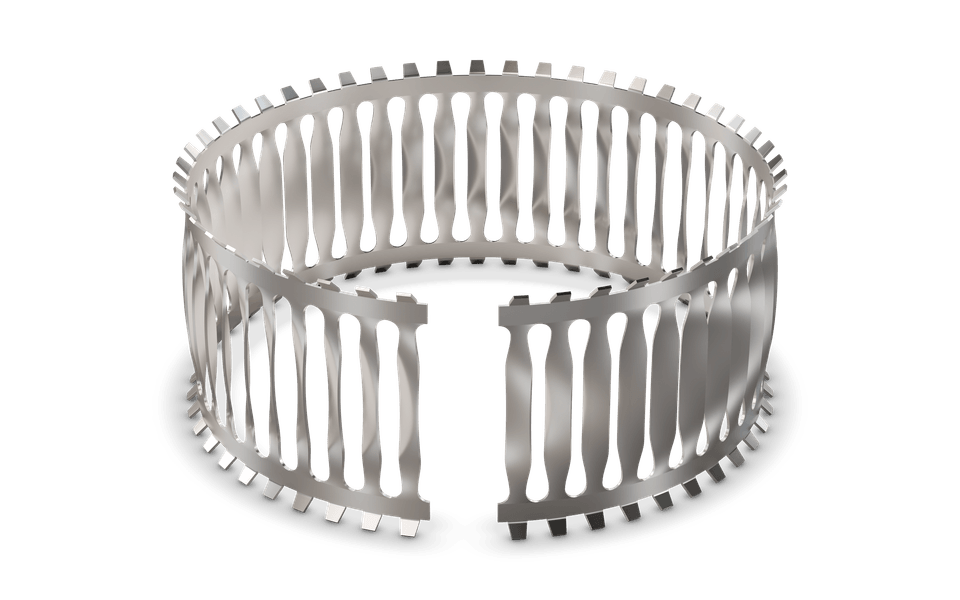
After age hardening, beryllium copper reaches the highest strength of all copper alloys and keeps its spring force at elevated temperature. That is why ACA makes its leaf spring contact band and its torsion spring contact band from CuBe only. CuBe is either formed in the solution-annealed condition and age-hardened afterwards, or processed as mill-hardened strip that needs no further heat treatment. ACA processes both conditions, depending on the part, and age-hardens solution-annealed CuBe in-house after forming. Operations that create dust or fumes, such as grinding or welding, require protective measures. REACH information duties apply to beryllium-containing articles along the supply chain. ACA provides REACH Article 33 information on beryllium as a substance of very high concern (SVHC) for CuBe parts on request.
-
Phosphor bronze (CuSn)
e.g. CuSn6, CW452K
Tin bronze, usually called phosphor bronze, is the classic spring material of electrical engineering: strong, easy to bend, easy to solder and plate, and available in many tempers. Its weak points are comparatively low conductivity and moderate stress relaxation resistance at higher temperatures. For contact springs, clamping springs and signal contacts at normal ambient temperature, CuSn is often the most economical choice.
-
Brass (CuZn)
e.g. CuZn37, CW508L
Brass is inexpensive, forms very well and conducts better than phosphor bronze. It is of limited use for springs because it relaxes quickly under load. Typical applications are flat tabs, solder tags, terminal clamp bodies and connection parts without a permanent spring function.
-
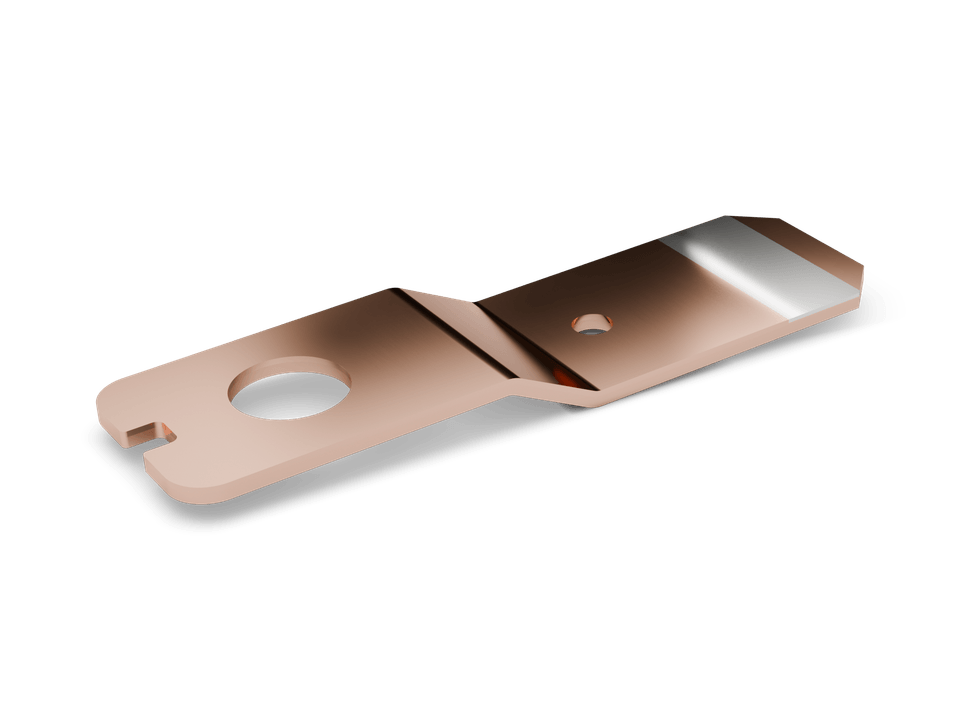
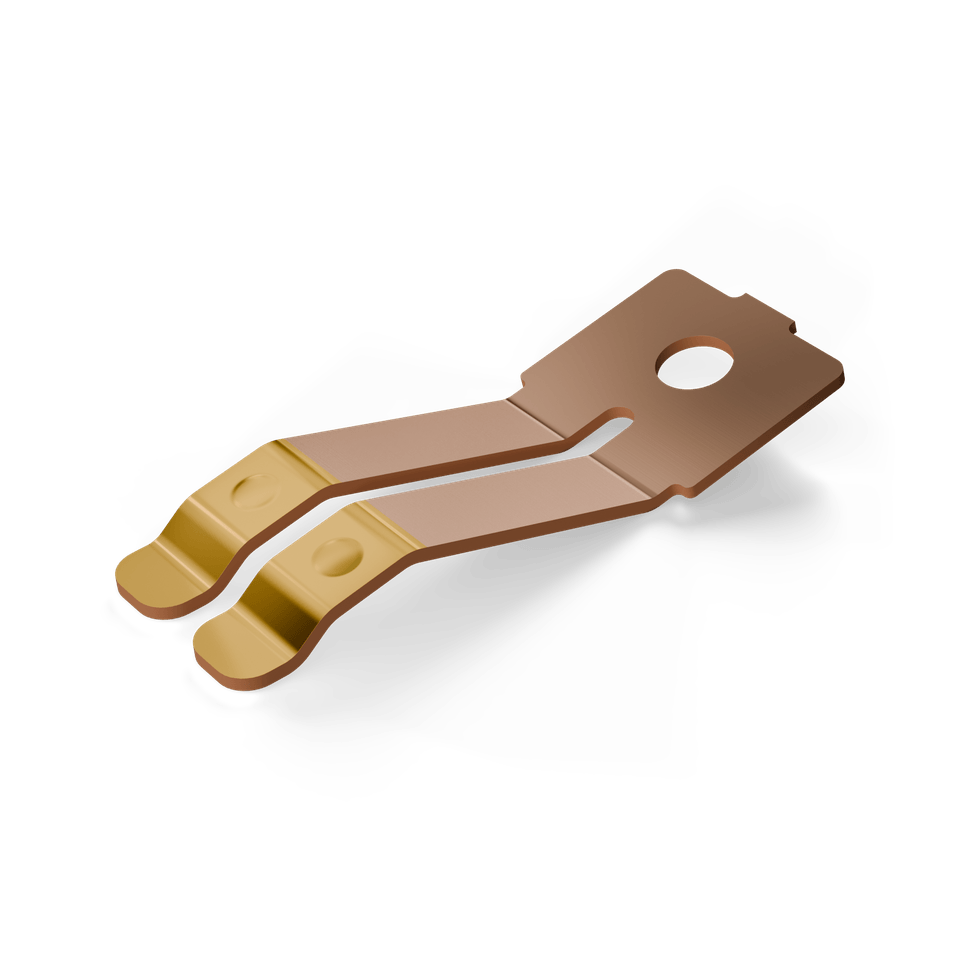
Copper Contact part from clad copper strip with a rolled-in silver stripe -
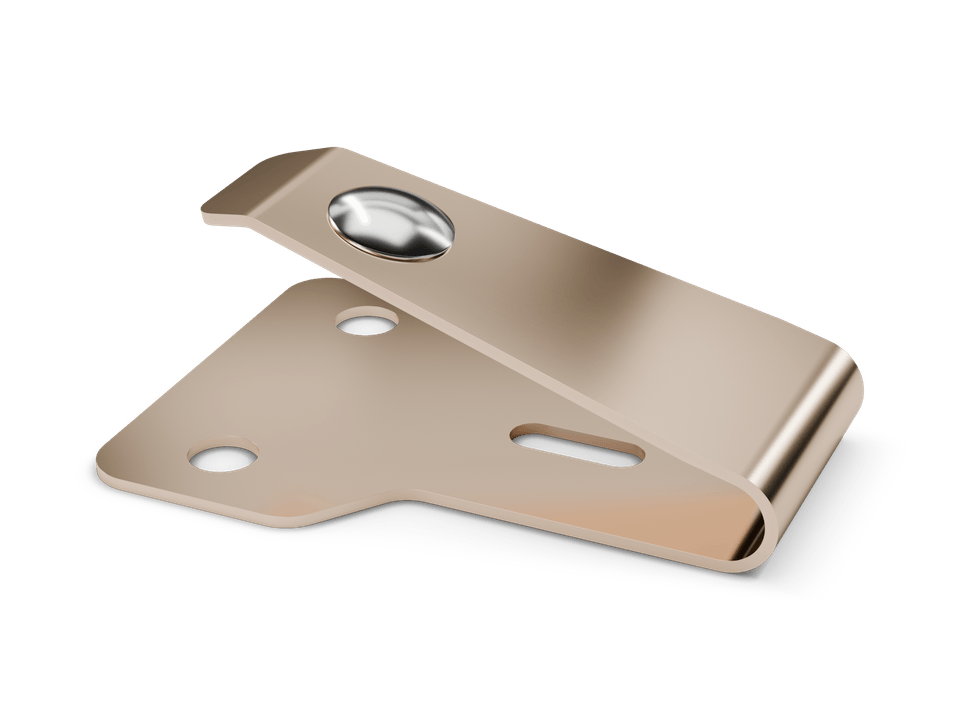
Copper alloy Contact spring with a hairpin bend and a riveted silver contact
04
Stainless and carbon spring steel
-
Stainless spring steel
e.g. 1.4310 (X10CrNi18-8)
Stainless spring steel offers high spring force, very good stress relaxation resistance and corrosion resistance, but conducts poorly. It suits retaining springs, spring clips and clamping springs, and any design where the spring provides the force while another material carries the current. In the ACA high-current contact band, stainless spring steel forms the carrier strip that generates the contact force.
-
Carbon spring steel
e.g. C75S (1.1248)
Carbon spring steel is the most economical route to high spring force, for example for retaining and locking springs without an electrical function. It needs corrosion protection. When high-strength steels are electroplated, the process sequence must take the risk of hydrogen embrittlement into account.
-
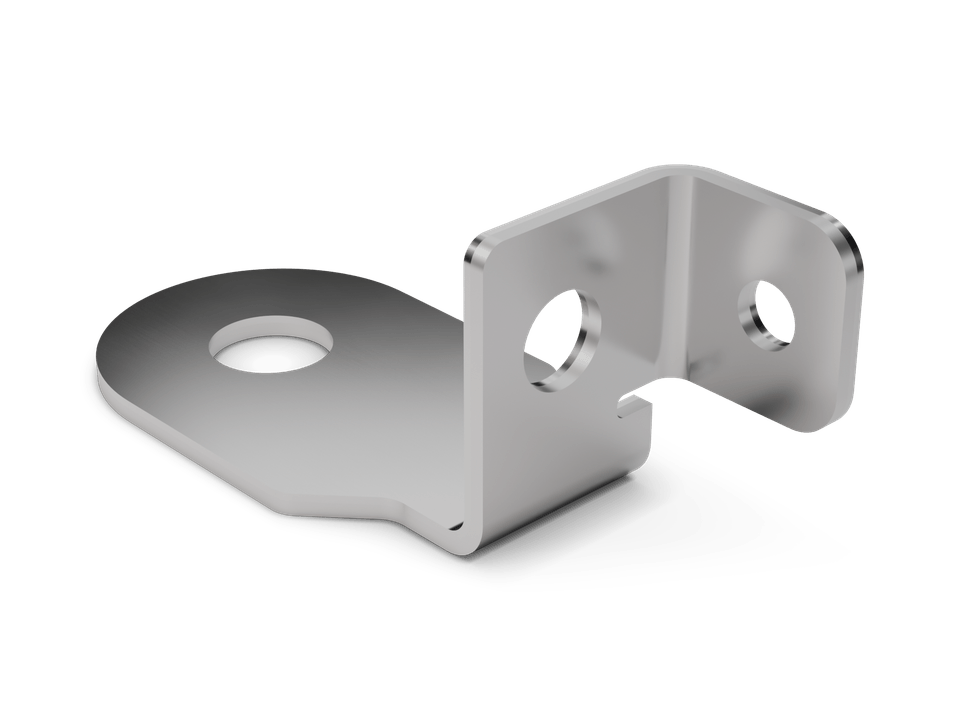
Stainless steel Bracket with mounting hole, 90 degree leg and bent lug -
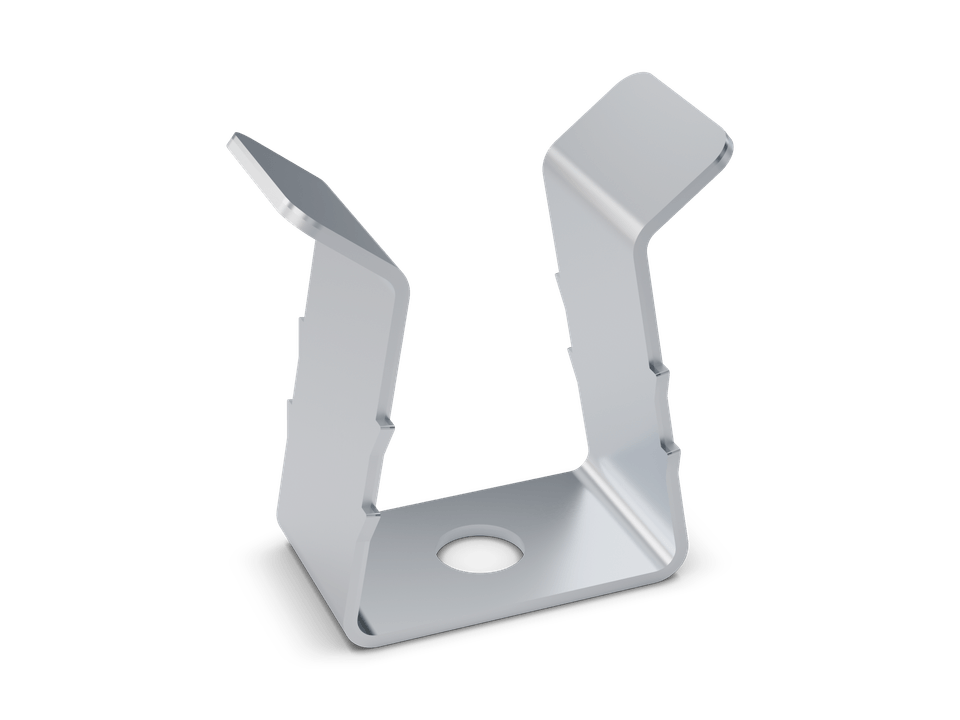
Spring steel, zinc-plated Spring clip with lead-in flares and retention barbs
05
Choosing a material: four rules of thumb
The starting point is not the material but the function of the part. The following rules lead to the right material family in most cases. We then select the alloy and temper together with you, matched to deflection, force and temperature.
- High current, little deflection: copper or CuFeP, silver or tin plated.
- Spring force at elevated temperature: CuBe or CuNiSi, for their stress relaxation resistance.
- Spring force at room temperature on a tight budget: CuSn, or brass if the spring function is minor.
- Separate force and current: a steel spring for the force, copper for the current, joined by riveting or welding.
06
Silver, tin, gold or nickel: finishes compared
| Criterion | Contact resistance | Required contact force | Mating cycles | Cost level | Typical use |
|---|---|---|---|---|---|
| Silver (Ag) | very low | medium | medium to high, with passivation or lubrication | medium | high current, power contacts, contact lamellae |
| Tin (Sn) | low, as long as the oxide film is broken | high | low | low | solder terminations, rarely mated connections |
| Gold (Au) | very low and stable | low | high | high | signal and measuring contacts, low currents and voltages |
| Nickel (Ni) | medium to high, due to oxide film | high | medium | low to medium | barrier layer under Au, Ag or Sn, wear and corrosion protection |
Tendencies for common thicknesses and layer systems. How a finish behaves in service depends on thickness, underlayer, contact force, mating contact and environment.
07
Which finish when?
-
Silver (Ag)
silver plated, passivated
Silver has the highest electrical conductivity of all metals and forms no insulating oxide. That makes it the usual finish for high-current contacts and high-current contact lamellae. In sulphur-bearing atmospheres silver tarnishes. At low contact force the sulphide film can raise contact resistance, and a passivation delays tarnishing. When sliding, silver tends to cold-weld, so a low-friction passivation or a contact lubricant reduces friction and wear. The ACA torsion spring contact band is silver plated and passivated as standard, and the contact pieces of the high-current contact band carry 20 µm of silver as standard.
-
Tin (Sn)
electroplated or hot-dip tinned
Tin is the economical finish for solder terminations and for connections that are rarely mated. Tin is soft and oxidises in air. The oxide film has to be broken by sufficient contact force on mating. Under vibration and temperature cycling, tin-plated contacts are prone to fretting corrosion, because every micro-movement creates fresh oxide. With pure electroplated tin, whiskers can also grow, especially at tight spacings in electronics.
-
Gold (Au)
gold plated, usually hard gold over nickel
Gold does not oxidise and keeps contact resistance stable even at low contact force, low current and low voltage. That makes gold the first choice for signal, measuring and data contacts and for contacts with many mating cycles. Plug contacts usually use thin, hardened gold layers over a nickel barrier. Because gold is expensive, it is often applied selectively to the contact zone only.
-
Nickel (Ni)
nickel plated, also as underlayer
Nickel is hard, wear-resistant and corrosion-resistant. As an underlayer it stops copper and zinc diffusing from the base material into the top layer and so extends the life of gold, silver and tin finishes. As a contact surface, nickel forms a thin oxide film and needs higher contact forces. For contact lamellae in standard applications, nickel is an economical option: the ACA leaf spring contact band is available nickel, silver or gold plated.
-
Selective plating
partial or stripe plating
With selective plating, only the functional zone receives the expensive layer, for example gold on the contact zone and tin on the solder termination. This saves precious metal and is common for reel-to-reel plated parts. ACA supplies electroplated and selectively plated strip and processes clad strip and contact profiles. Plating is carried out by specialised partner companies, see surface finishes.
08
Layer systems and the right sequence
A finish is rarely a single layer. A typical build-up is base material, nickel barrier and a top layer of gold, silver or tin. For the design, it also matters when plating takes place: before stamping, afterwards on the strip, or as loose parts. The sequence determines edge protection, formability and cost.
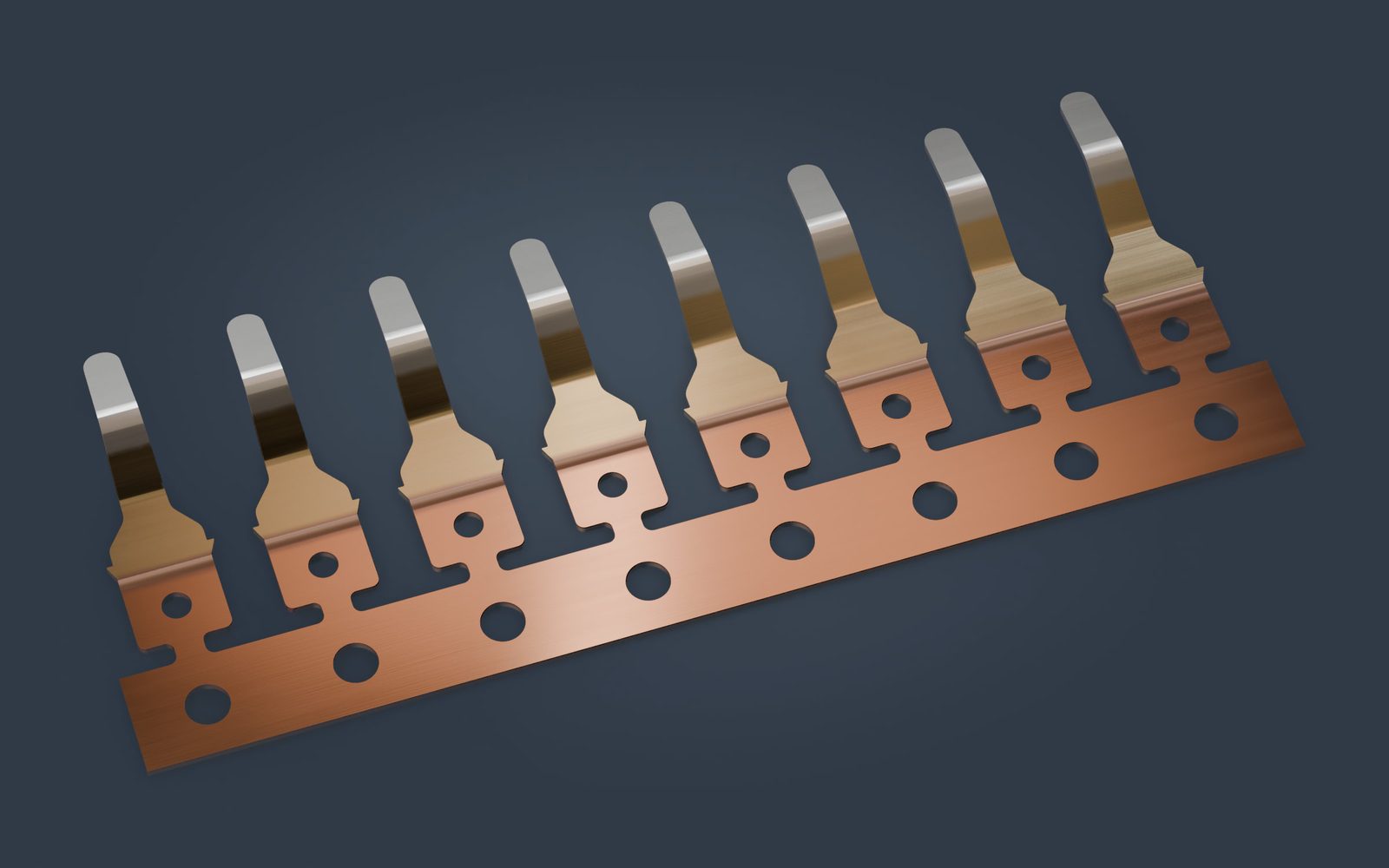
- Pre-plated strip: economical in large quantities. Cut edges stay unplated, and bends are formed through the finished layer.
- Plating after stamping, on the strip: edges are plated too, selective zones are possible, and the parts stay on the carrier strip for further processing.
- Barrel plating of loose parts: for parts that are to be plated all over. Not suitable for delicate geometries that tangle.
Layer build-up
Base material, nickel barrier layer and a top layer of gold, silver or tin.
Pre-plated strip
Economical in high volumes. The cut edges stay unplated.
Plated after stamping
The edges are plated too, and selective zones are possible.
Selective plating
For example gold on the contact zone and tin on the solder tail.
09
The mating contact counts too
A contact is always a pair. The basic rule: identical or compatible finishes on both sides. Gold against tin is considered a poor pairing, because the soft tin transfers onto the gold during micro-movements and oxidises there.
The base material of the mating contact also affects the current rating. According to the datasheets for our contact bands, the resistance per web rises by around 40 % when the mating contact is silver-plated brass instead of silver-plated copper. The permissible current then falls to 60 % of the value for copper. If you make the pin and socket yourself, choose their material and finish as carefully as the lamella.
10
Example: materials and finishes of ACA contact lamellae
| Property | Value |
|---|---|
| Leaf spring contact band · base material | beryllium copper (CuBe), relaxation-resistant |
| Leaf spring contact band · finish | nickel, silver or gold |
| Torsion spring contact band · base material | beryllium copper (CuBe), relaxation-resistant |
| Torsion spring contact band · finish | silver plated and passivated, alternatively bare |
| Torsion spring contact band · silver layer | on request |
| High-current contact band · carrier strip | stainless spring steel |
| High-current contact band · contact pieces | copper, silver plated, passivated for low friction |
| High-current contact band · copper contact thickness | 0.6 mm |
| High-current contact band · silver layer (standard) | 20 µm |
Data from ACA datasheets, installation drawings and the previous product page. Layer thicknesses on request. The leaf spring and torsion spring contact bands are made only from CuBe. Details per design on the contact lamellae page.
Last updated: