01
Shared terminology, fewer follow-up questions
In stamping and contact technology, the same part often goes by several names: stamped and bent part, stamped and formed part, stamped-bent part or punched and formed part, contact lamella, lamella contact or louvered contact band. This glossary sorts out the most important terms, explains each in one to three sentences and points you to the page where you can find out more.
For the bigger picture, read our guides to materials and finishes, contact types and designing stamped parts.
02
Terms from A to Z
No term found. Try a shorter search.
A
- Age hardening
- More on this: Materials and finishes
Age hardening (precipitation hardening) is a heat treatment in which very fine precipitates form in a solution-annealed alloy and greatly increase strength and spring properties. Beryllium copper is usually formed in the soft, solution-annealed condition and age-hardened afterwards. ACA age-hardens solution-annealed CuBe in-house after forming.
- Assembly
- More on this: Assemblies
An assembly consists of several individual parts joined into a ready-to-install unit. ACA makes riveted and welded assemblies from stamped and bent parts and contacts.
-
B
- Basket spring
- More on this: Contact springs
A basket spring is a spring rolled into a basket shape with several spring webs. It is fitted into a socket and grips the inserted pin. The socket version of the leaf spring contact band is also called a contact basket.
- Bend radius
- More on this: Designing stamped parts
The bend radius is the inside radius of a bend. How small it can be depends on material, temper, sheet thickness and orientation to the rolling direction. Radii that are too small cause cracks on the outside of the bend.
- Beryllium copper (CuBe)
- More on this: Materials and finishes
Beryllium copper is an age-hardenable copper alloy with very high strength and very good stress relaxation resistance. ACA makes its leaf spring and torsion spring contact bands from CuBe only and age-hardens solution-annealed CuBe in-house.
- Brass (CuZn)
- More on this: Materials and finishes
Brass is a copper-zinc alloy, inexpensive and very easy to form. It is of limited use for springs, but a common material for flat tabs, solder tags and terminal clamp bodies.
- Bulk (loose parts)
- More on this: Stamped and bent parts
Bulk parts are loose, separated parts supplied unordered in containers. Bulk is the simplest delivery form for parts that are assembled by hand or through feeding systems.
- Burr
- More on this: Designing stamped parts
The burr is the sharp raised edge that forms on the exit side of the punch during stamping. The burr side should be stated on the drawing. In bent parts, the burr should be on the inside of the bend wherever possible.
C
- Cage spring (spring-clamp terminal)
- More on this: Terminal parts
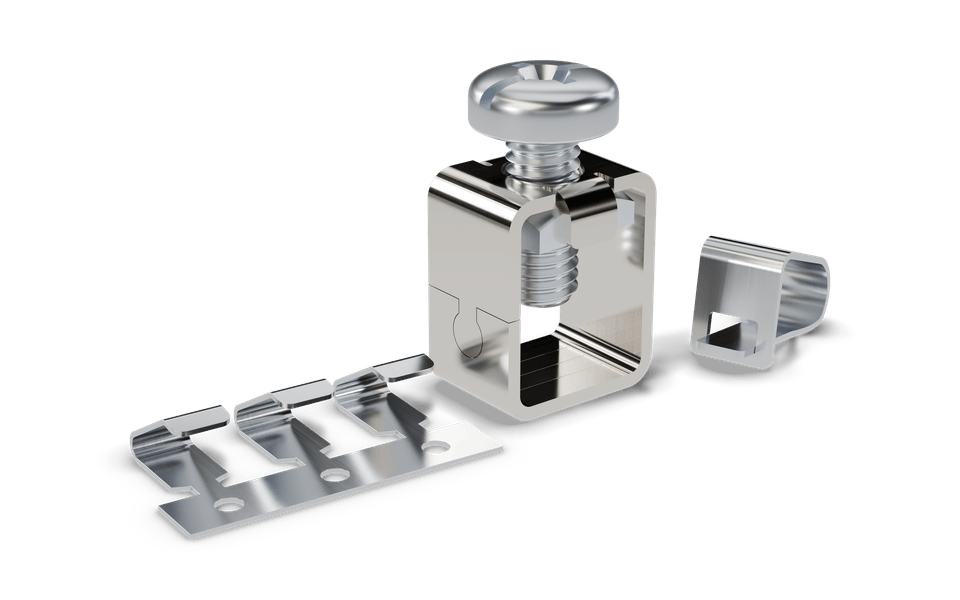
A cage spring is the spring in a spring-clamp terminal that presses the inserted conductor permanently against the contact part of the terminal. It makes a clamping screw unnecessary and holds the clamping force under vibration.
-
- Canted coil spring
- More on this: Contact types compared
A canted coil spring is a wire spring closed into a ring, with coils inclined to the spring axis, that sits in a groove. Its force stays almost constant over a long deflection, and each coil forms a contact point.
- Cantilever contact
- More on this: Contact types compared
A cantilever contact (spring-beam contact) is a stamped contact in which one or more spring arms provide the contact force, for example in flat receptacles and fork contacts. Contact and spring are one single stamped part that can be produced economically in large quantities.
- Carrier strip
- More on this: Designing stamped parts
The carrier strip is the part of the strip that transports the stamped parts through the progressive die. Pilot holes in the carrier locate the strip in every station. With parts on reel, the parts stay on the carrier until assembly.
- Clad strip
- More on this: Contact strips
Clad strip consists of a base material onto which a contact material is roll-bonded, either as a stripe or over the full surface. Parts stamped from it carry the contact material exactly where it is needed. ACA processes clad strip and contact profiles.
- Clamp frame
- More on this: Terminal parts
A clamp frame, also called a terminal clamp body, is the stamped part of a screw terminal that holds the conductor and the clamping screw. It is mounted hooked in and carries a formed thread or a captive nut, which allows a compact design.
- Clamping spring
- More on this: Contact springs
A clamping spring holds a component or a conductor in place by spring force. As a contact spring it also provides the electrical connection, as a pure retaining spring only the mechanical fixing.
- Coining
- More on this: Tool making
Coining is a forming process in which a punch displaces material locally without cutting it. In a progressive die it produces contact dimples, beads, reduced cross-sections or coined edges. ACA coins contact dimples, beads and reduced cross-sections in the stamping die.
- Contact bridge
- More on this: Riveted and welded contact parts
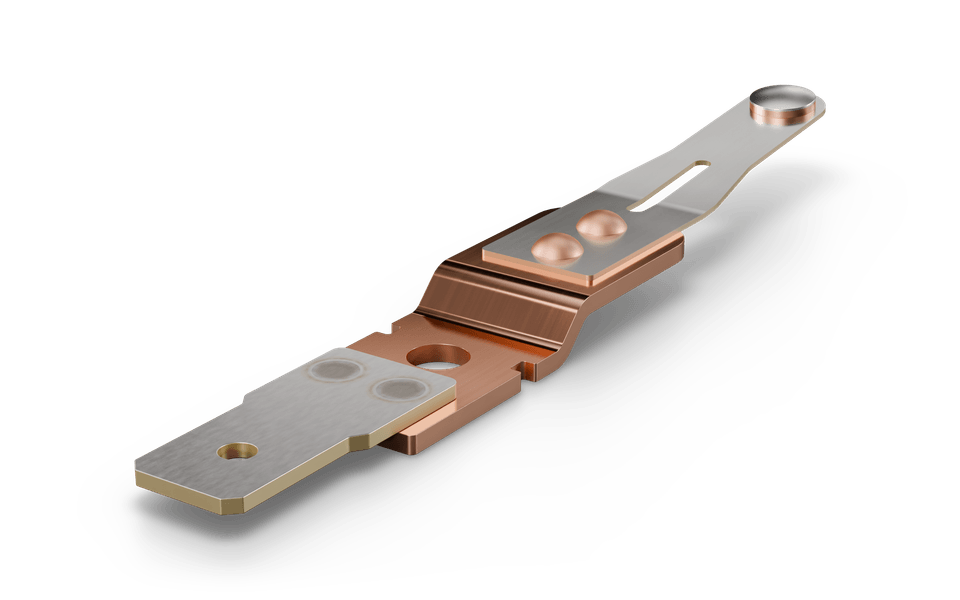
A contact bridge is a carrier with two or more contact points that electrically connects two terminals in switchgear. The contact tips are riveted or welded on.
-
- Contact dimple
- More on this: Stamped and bent parts
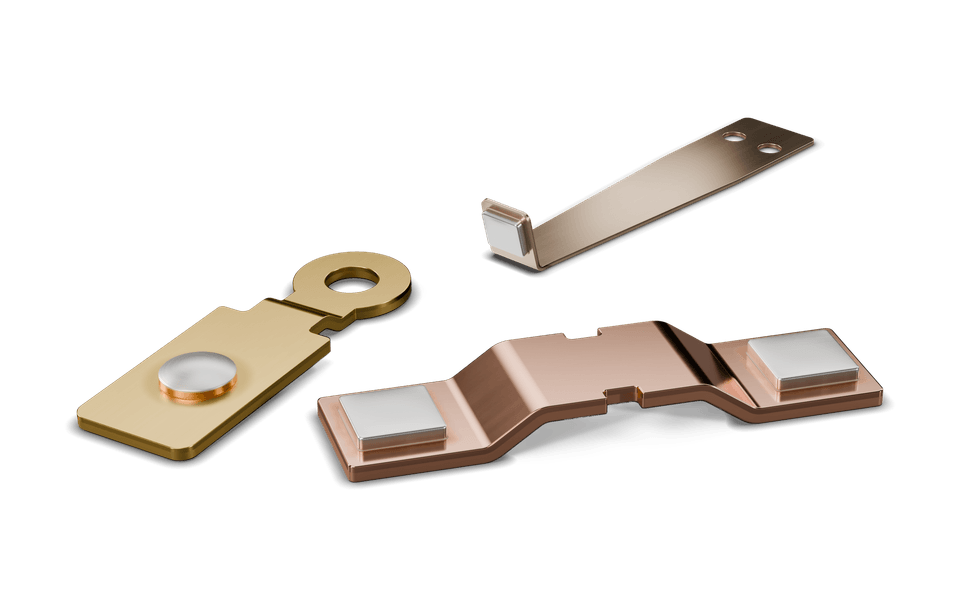
A contact dimple is a small embossed bump on a contact surface. It concentrates the contact force on a defined spot, raises the contact pressure there and makes the position of the contact point repeatable. ACA coins contact dimples in the stamping die.
- Contact lamella
- More on this: Contact lamellae
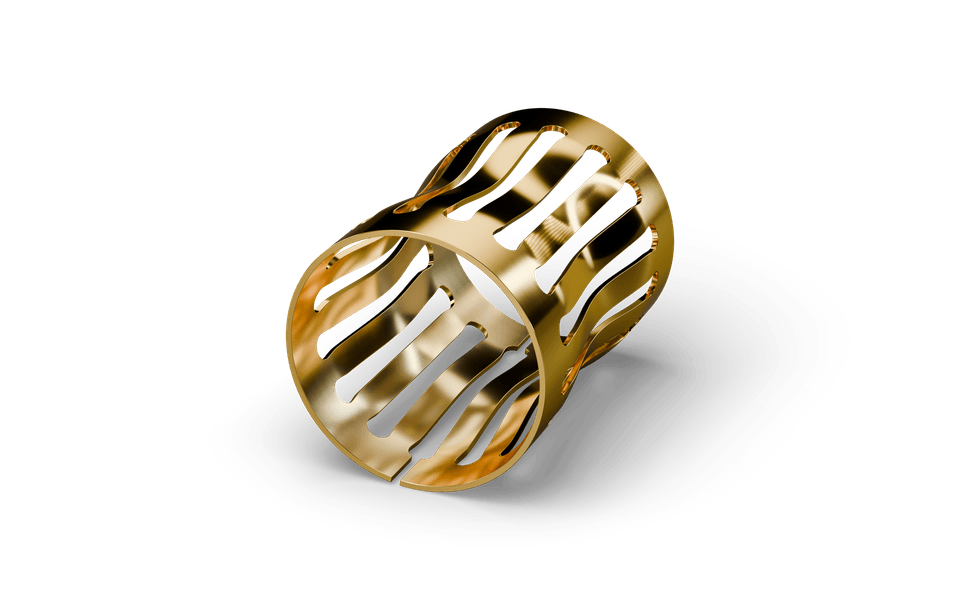
A contact lamella (lamella contact, louvered contact band) is a stamped contact band with many parallel spring webs that bridges the gap between pin and socket. The current is shared across many contact points, which lowers contact resistance. ACA makes contact lamellae in leaf spring, torsion spring and high-current designs.
- Contact normal force
- More on this: Contact types compared
The contact normal force is the force with which a contact presses perpendicularly on its mating surface. It determines contact resistance, wear and insertion force.
- Contact resistance
- More on this: Contact types compared
Contact resistance is the electrical resistance at the interface of two contact surfaces. It depends on contact force, finish, surface films and the number of contact points, and it determines how much a contact heats up.
- Contact spring
- More on this: Contact springs
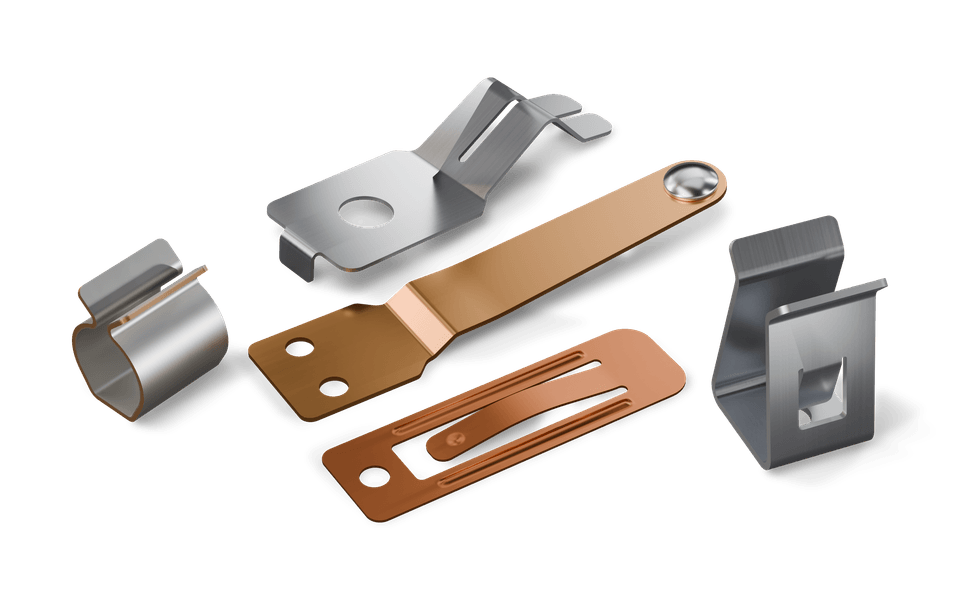
A contact spring is a resilient component that makes an electrical connection and holds it with a defined force. It is usually stamped and bent from copper alloys and designed to a force-travel specification.
-
- Contact strip
- More on this: Contact strips
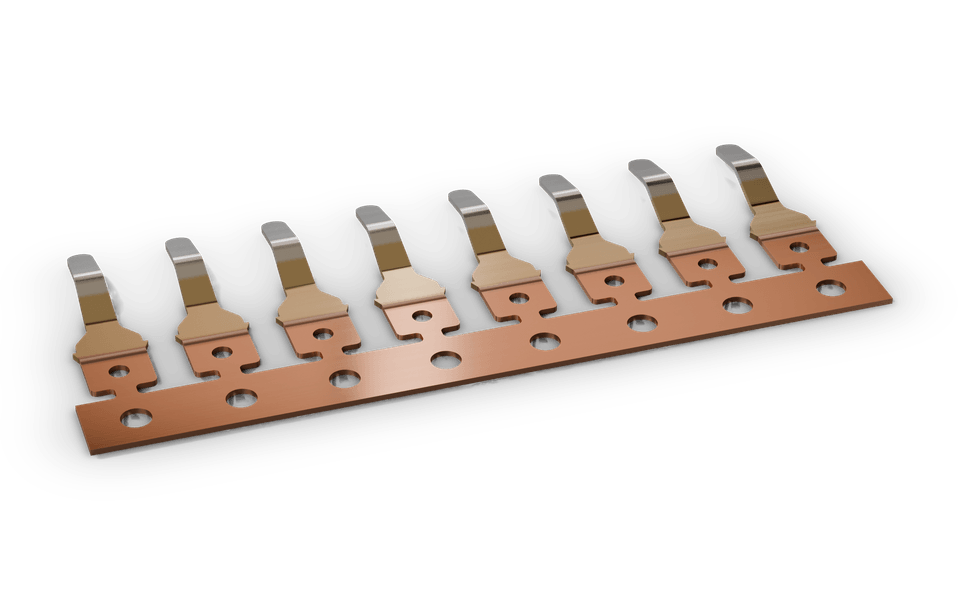
A contact strip is a strip of stamped contacts held at a fixed pitch on the carrier strip. Multi-component contact strips combine two or more materials in one part, for example a spring material with a contact material.
- Contact tip
- More on this: Riveted and welded contact parts
A contact tip is the piece of contact material, for example a silver-based material, that sits on a carrier and forms the actual contact surface. The carrier provides spring force, current conduction and mounting. ACA welds contact tips on inline in the stamping process or rivets them on at a separate riveting station.
- Contact welding
- More on this: Contact welding and riveting
Contact welding means welding contact material onto a carrier, usually by resistance welding. ACA welds two-component contact parts inline in the stamping process.
E
- EDM (electrical discharge machining)
- More on this: Tool making
EDM (electrical discharge machining, spark erosion) removes metal by electrical discharges between an electrode and the workpiece, without the two touching. This allows even hardened tool steels to be machined precisely. In wire EDM, a thin wire cuts the contour. In the ACA tool shop, the contours of the tool components are EDM-cut, with in-house EDM technology since 1999.
- Extruded hole
- More on this: Threading and assembly
An extruded hole is a hole whose edge is drawn up into a collar during stamping. A thread in an extruded hole is longer than the sheet is thick and therefore carries more thread turns. ACA also forms threads in extruded holes, inline in the stamping die.
F
- Flat receptacle
- More on this: Flat tabs and receptacles
A flat receptacle is the counterpart of the flat tab. Rolled-in, resilient side walls create the contact force on the tab.
- Flat tab
- More on this: Flat tabs and receptacles
A flat tab is a flat, blade-shaped plug contact that mates with a flat receptacle. Flat tabs are stamped from copper alloys and, for example, soldered on or inserted into components.
- Force-travel characteristic
- More on this: Contact springs
The force-travel characteristic describes the force a spring exerts at each deflection. It is the most important specification for contact springs. ACA checks force-travel requirements during series production.
- Fork contact
- More on this: Plug contacts
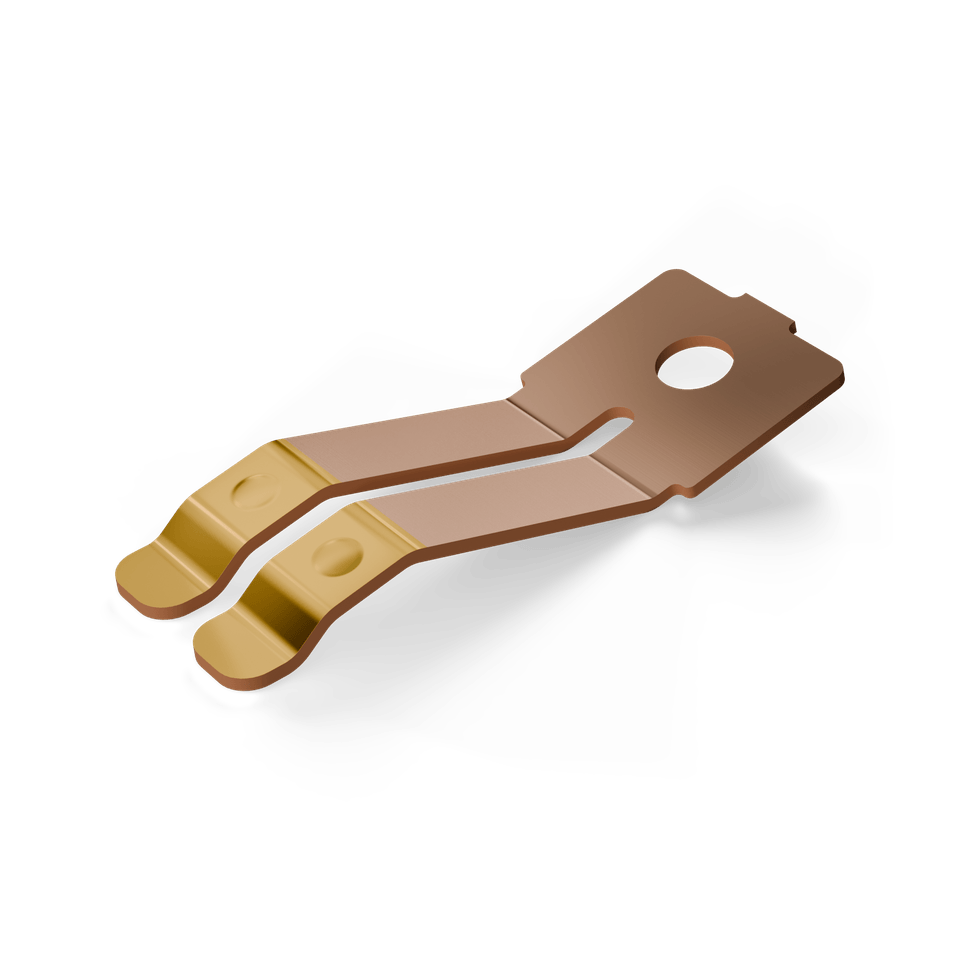
A fork contact is a stamped plug contact with two opposing spring arms that clamp a mating part such as a blade, a pin, a copper bar or a board edge between them. The typical design is the flat stamped fork, whose cut edges contact the mating part. The preload of the arms creates the contact force at two contact points. How the fork contact differs from other contact types is shown in the contact types comparison.
- Fretting corrosion
- More on this: Materials and finishes
Fretting corrosion occurs when two contact surfaces move minimally against each other through vibration or temperature cycling. On base-metal finishes such as tin, fresh oxide keeps forming and contact resistance rises. Remedies are higher contact force, precious-metal finishes or contact lubricant.
G
- Grounding spring
- More on this: Contact springs
A grounding spring (earthing spring) is a contact spring that connects two components electrically, for example a housing part and a mounting plate, so that both are at the same potential. It is usually made as a stamped and bent part from spring material.
H
- High-current contact
- More on this: Contact lamellae
A high-current contact is an electrical contact designed to carry high continuous currents. To keep the contact point from overheating, it needs a low contact resistance, usually achieved with many parallel contact points, highly conductive materials and a silver finish. At ACA, the torsion spring and high-current contact bands do this job in connectors.
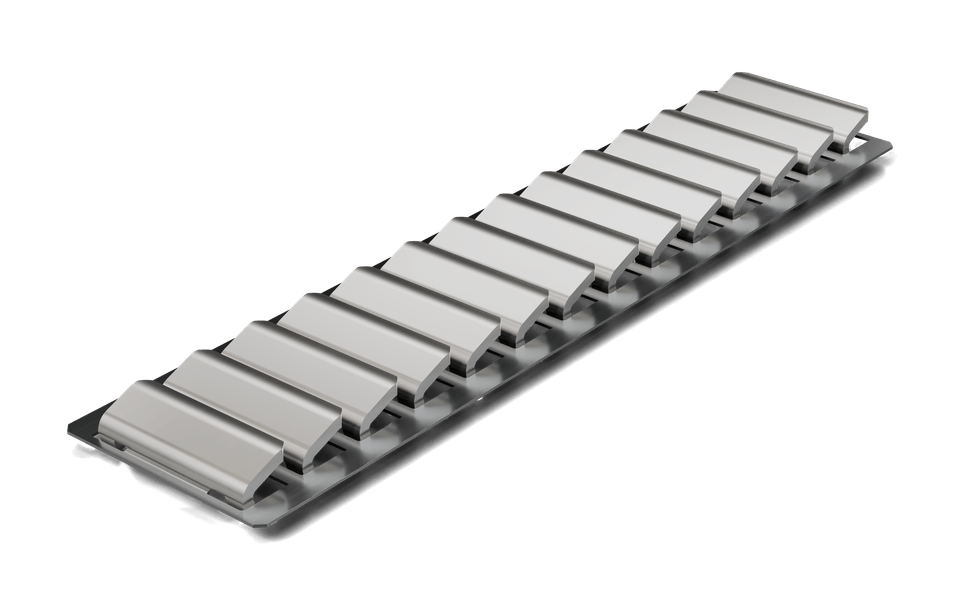
- High-current contact band
- More on this: High-current contact band
The ACA high-current contact band is a two-component contact band: a carrier strip of stainless spring steel generates the contact force, and riveted, silver-plated copper contact pieces carry the current. It works with low contact forces and also suits moving parts.
-
- Hyperboloid contact
- More on this: Contact types compared
A hyperboloid contact is a socket in which straight wires are stretched at an angle to the axis, forming a hyperboloid. The wires grip the pin along lines. This gives low insertion forces and a very high number of mating cycles, at a high manufacturing cost. ACA does not make hyperboloid contacts.
I
- IACS
- More on this: Materials and finishes
IACS (International Annealed Copper Standard) is the reference for the electrical conductivity of metals. 100 % IACS corresponds to 58 MS/m at 20 °C, the conductivity of annealed pure copper.
- Insertion force
- More on this: Contact types compared
Insertion force is the force needed to mate a connector. As an approximation: insertion force ≈ friction coefficient × contact normal force per contact point × number of contact points. A contact lubricant reduces it.
L
- Lamella contact
- More on this: Contact lamellae
Lamella contact is another name for the contact lamella. The term stresses the principle: many parallel webs form many contact points that share the current. Louvered contact band and contact band refer to the same component.
- Leaf spring contact band
- More on this: Leaf spring contact band
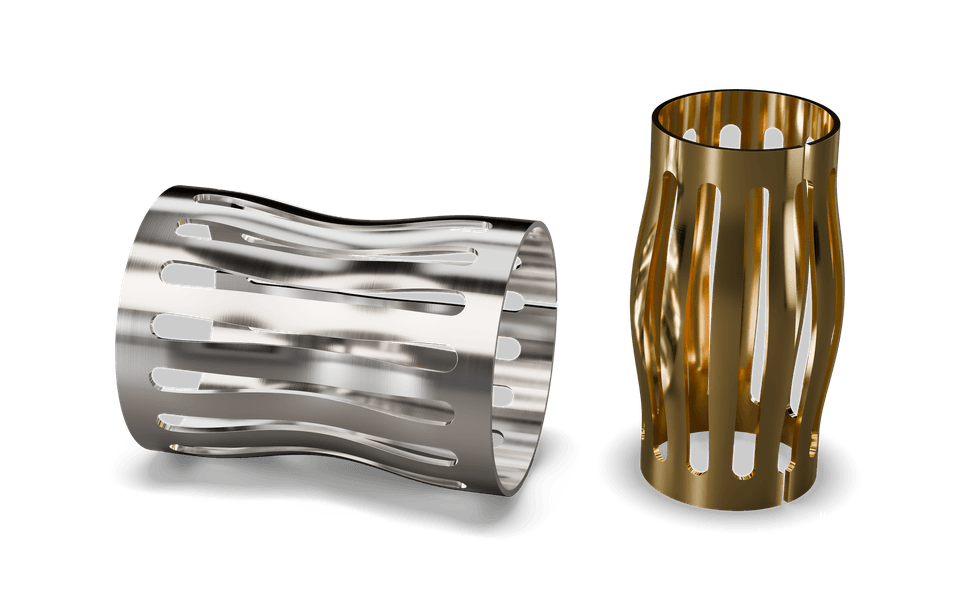
A leaf spring contact band (leaf spring contact lamella) is a lamella contact whose webs are loaded in bending. It is supplied pre-rounded to the mating diameter and fitted into a groove on the pin or in the socket. The socket version rolled into a basket is also called a contact basket.
-
- Louvered contact band
- More on this: Contact lamellae
Louvered contact band, louver band and contact band are other names for the contact lamella: a stamped band with many parallel spring webs (louvers) that sits in a groove on the pin or in the socket. ACA calls its three designs the leaf spring, torsion spring and high-current contact band.
M
- Magazine packaging
- More on this: Stamped and bent parts
With magazine packaging, parts arrive ordered in magazines so that they can be fed into assembly machines in the correct orientation. ACA offers it alongside parts on reel, taped parts and bulk.
- Mating cycles
- More on this: Contact types compared
Mating cycles state how often a connector can be mated and unmated before contact resistance or wear exceeds a limit. They depend mainly on finish, contact force and lubrication.
- Multi-point contact
- More on this: Contact lamellae
A multi-point contact shares the current across many parallel contact points. Because the individual resistances are in parallel, the total resistance falls and tolerances are compensated. Lamella contacts are the best-known design.
P
- Parts on reel
- More on this: Contact strips
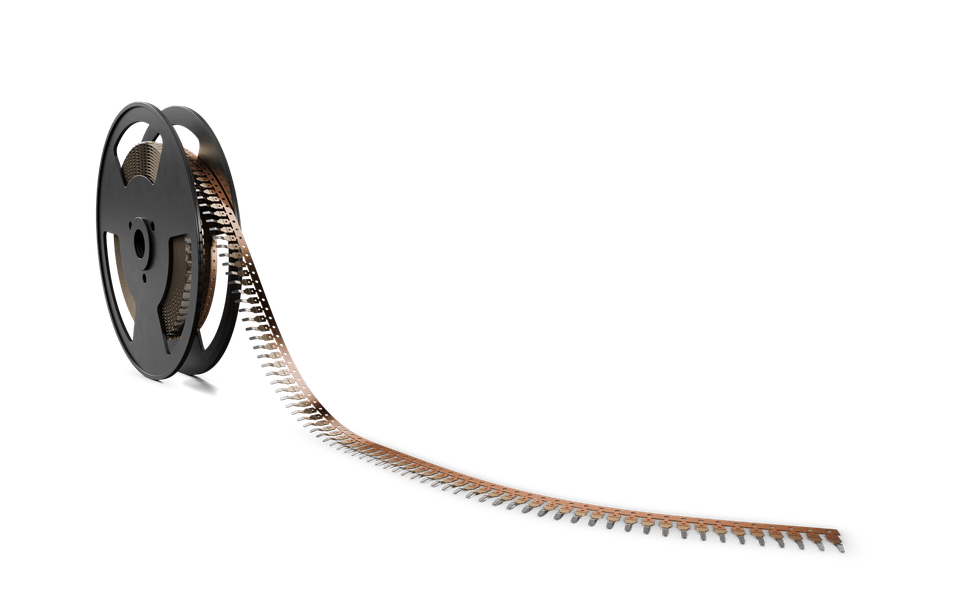
Parts on reel are stamped parts that stay on the carrier strip after stamping and are delivered wound on reels. They can be fed straight into placement and assembly machines. ACA supplies stamped parts and contacts on reel, on tape, in magazines or as bulk.
-
- Passivation
- More on this: Materials and finishes
A passivation is a thin protective film on a metal surface, on silver for example against tarnishing. Low-friction passivations also reduce friction and insertion force. The ACA torsion spring contact band and the contact pieces of the ACA high-current contact band are silver plated and passivated as standard.
- Phosphor bronze (CuSn)
- More on this: Materials and finishes
Phosphor bronze is a copper-tin alloy and the classic spring material of electrical engineering. It is strong, easy to bend, solder and plate, but conducts considerably less well than copper.
- Pilot pin
- More on this: Designing stamped parts
A pilot pin engages a pre-punched pilot hole in the carrier strip at a station of the progressive die and locates the strip exactly before cutting or bending. This keeps feed tolerances from adding up over the stations.
- Pitch
- More on this: Contact lamellae
The pitch is the distance from one web of a contact band to the next. For the torsion spring contact band it is 2.5 mm at a band width of 17.5 mm and 2.0 mm at a band width of 13 mm, for the high-current contact band 3.5 mm. The band length is always a multiple of the pitch.
- Press-fit pin
- More on this: Press-fit pins
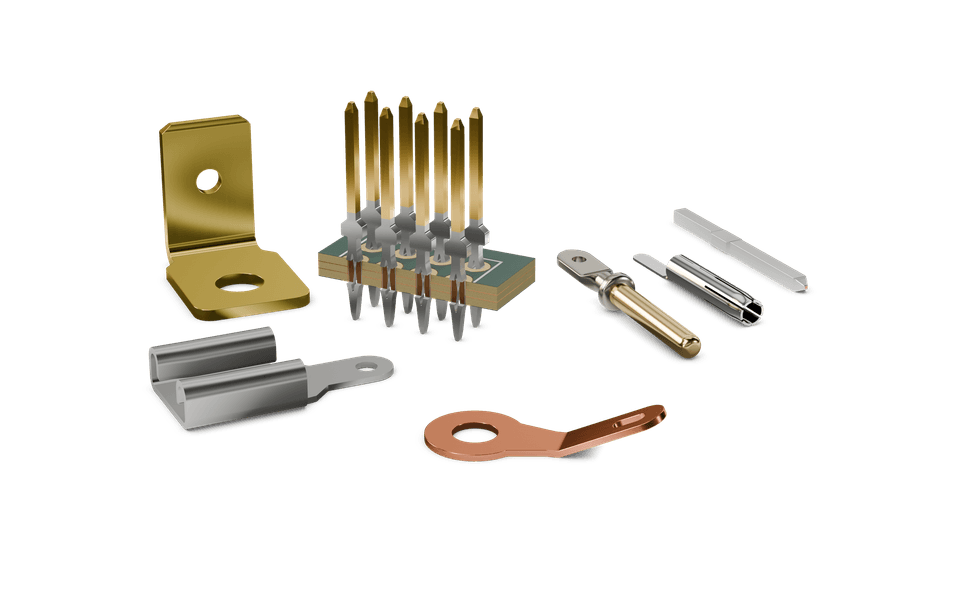
A press-fit pin is pressed into a plated through-hole of a printed circuit board without soldering. Its press-fit zone creates a mechanically strong, gas-tight connection. Requirements for press-in connections are described in IEC 60352-5.
-
- Press-fit zone
- More on this: Press-fit pins
The press-fit zone is the deformable section of a press-fit pin that deforms when pressed into the board hole, resiliently in the case of compliant zones. Its geometry determines insertion force, retention force and tolerance to the hole diameter.
- Progressive die
- More on this: Tool making
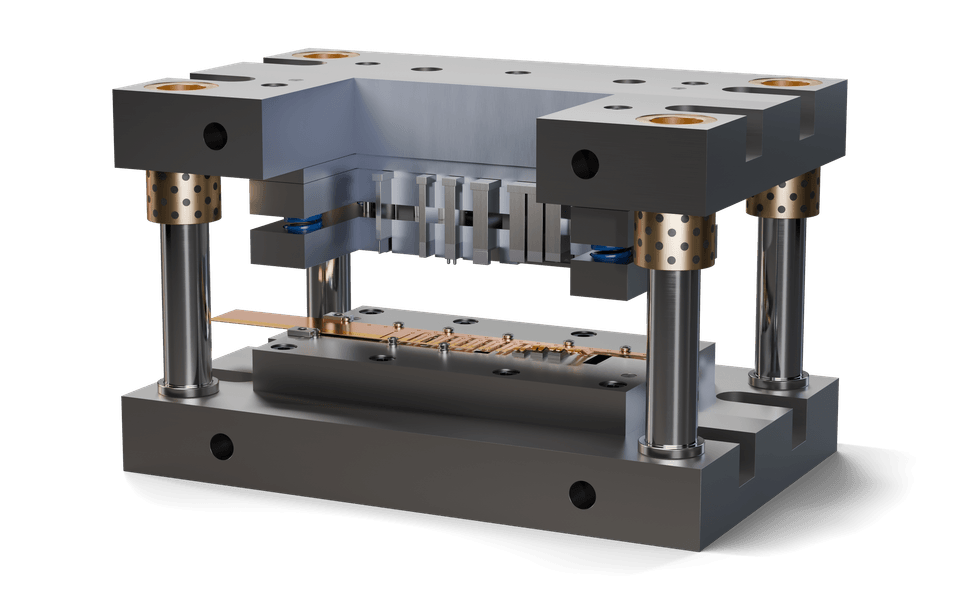
A progressive die is a stamping tool with several stations through which the strip advances by one pitch with every stroke. Cutting, bending and coining take place one after another until the finished part is cut off or stays on the carrier strip. ACA builds its stamping and bending tools in its own tool shop.
-
- Prototype
- More on this: Prototypes and low-volume production
A prototype or hand sample is an early sample part used to check function and fit before a series tool is built. ACA makes prototypes and low-volume runs.
R
- Resistance welding
- More on this: Contact welding and riveting
In resistance welding, a high current flows through electrodes and the two parts to be joined. The contact resistance at the interface generates heat, and under electrode force the materials fuse locally. ACA resistance-welds contact material inline in the stamping process.
- Retaining spring
- More on this: Contact springs
A retaining spring, also called a spring clip, holds components in position by spring force, without screws or adhesive. It is often stamped and bent from carbon spring steel, stainless spring steel or phosphor bronze.
- Riveted contact
- More on this: Riveted and welded contact parts
A riveted contact is a contact piece riveted onto a carrier, for example onto a contact bridge or a contact spring. ACA rivets contacts on a separate riveting station in-house.
- Rolled contact
- More on this: Round pin and socket contacts
A rolled contact is a contact stamped from strip and rolled into a sleeve, for example a rolled socket. In many cases it replaces a turned part and can be produced economically on reel in large quantities.
- Rolling direction
- More on this: Designing stamped parts
The rolling direction is the direction in which a metal strip was rolled. Bend lines across the rolling direction tolerate smaller radii than bend lines parallel to it.
S
- Selective plating
- More on this: Surface finishes
With selective plating, only part of a strip or component receives a particular layer, for example gold on the contact zone and tin on the solder termination. This saves precious metal. ACA supplies electroplated and selectively plated strip, with plating carried out by partner companies.
- Short-time withstand current
- More on this: High-current contact band
The short-time withstand current is the overcurrent a contact can carry for a short time without damage. Cross-section and heat capacity of the current-carrying parts are decisive, in the high-current contact band the copper contact pieces.
- Slotted socket
- More on this: Contact types compared
A slotted socket is a sleeve whose wall is divided by longitudinal slots into several spring fingers. The fingers are preloaded inwards and grip the inserted pin with few contact points and a relatively high force per point. A simple design and low cost come with a limited current rating.
- Solder tag
- More on this: Plug contacts
A solder tag is a stamped terminal to which a conductor or a circuit board is soldered. Solder pins do the same job in pin form. For good solderability they are usually tin plated.
- Springback
- More on this: Designing stamped parts
Springback is the elastic recovery of a bent part after bending. It is greater with spring-temper materials and large radii and is compensated in the tool by overbending.
- Square-wire pin
- More on this: Plug contacts
A square-wire pin is a plug contact with a square cross-section, formed from square wire or stamped from strip. ACA makes pin contacts from square wire to customer drawings.
- Stamped and bent part
- More on this: Stamped and bent parts
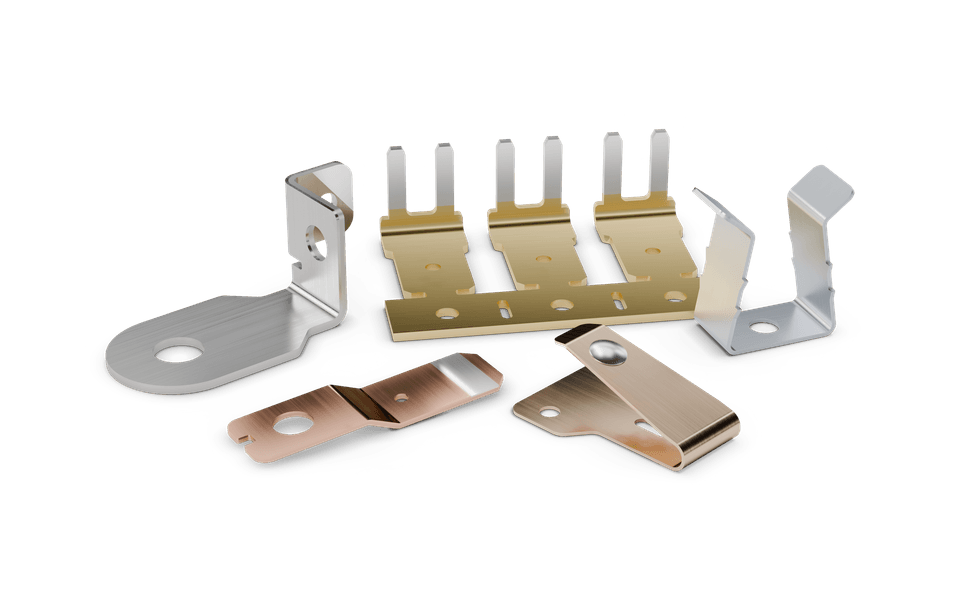
A stamped and bent part is a component cut and formed from metal strip, in volume production usually in a progressive die or on stamping and bending machines. Common variants of the term are stamped-bent part, stamped and formed part and punched and formed part. ACA makes precision stamped and bent parts from steel, stainless steel and non-ferrous metals.
-
- Stamped part
- More on this: Stamped and bent parts
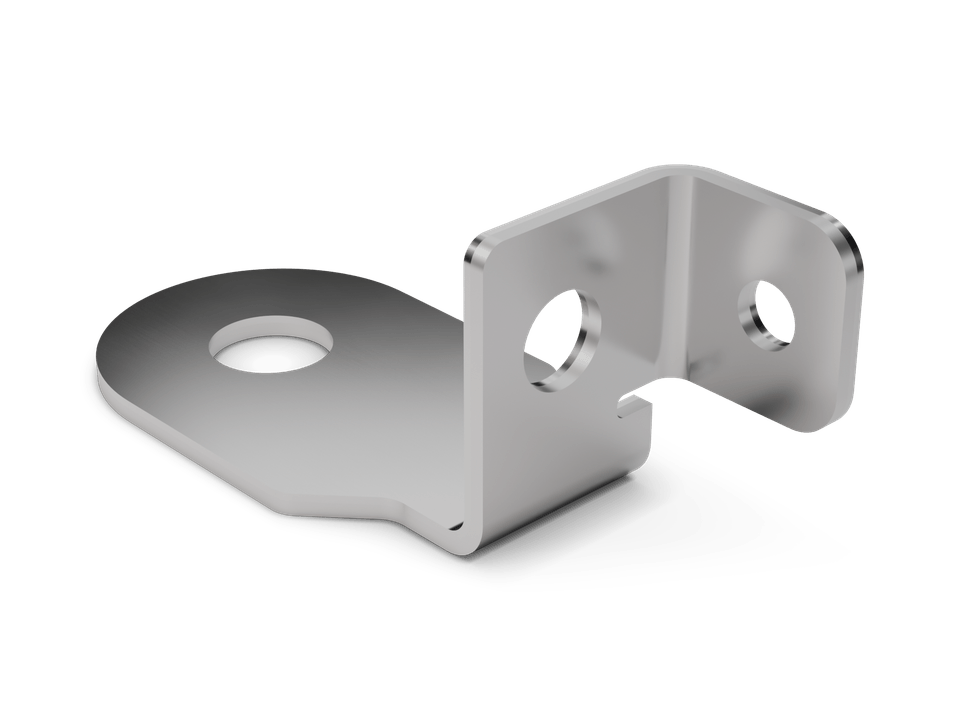
A stamped part is a component cut from sheet or metal strip, for example by piercing, blanking and notching in a stamping tool. If it is also bent or formed, it is called a stamped and bent part. In everyday use the two terms are often used interchangeably.
- Stamping and bending machine
- More on this: Stamped and bent parts
A stamping and bending machine performs cutting and bending operations with individually driven slides. This allows complex bent geometries to be made from strip or wire in one pass.
- Stamping and bending tool
- More on this: Tool making
A stamping and bending tool is the tool of a stamping and bending machine. Stamping takes place in the tool, bending is done by slides that work on the part from several directions. This produces complex three-dimensional bends as well as closed and rolled shapes from strip or wire. ACA designs and builds stamping and bending tools in its own tool shop.
- Stress relaxation
- More on this: Materials and finishes
Stress relaxation is the gradual loss of force of a preloaded spring, especially at elevated temperature. Relaxation-resistant materials such as beryllium copper, CuNiSi or stainless spring steel maintain the contact force over the service life.
- Strip layout
- More on this: Tool making
The strip layout shows how a part is made station by station in a progressive die: which operation runs in which station, how the part is attached to the carrier strip and how much material is left over. It is the basis of the tool design. ACA develops the flat pattern and strip layout from your part drawing.
- Switching contact
- More on this: Switching contacts
A switching contact is the current-carrying contact part of a switching device that opens and closes a circuit. It usually consists of a carrier with riveted or welded contact material.
T
- Taped parts
- More on this: Contact strips
Taped parts are contact parts supplied not loose but at a fixed pitch on a tape or carrier, either on their own carrier strip or held in a tape. This allows them to be fed and placed automatically.
- Tapping (thread cutting)
- More on this: Threading and assembly
In tapping, a tap cuts an internal thread into a pilot hole, producing chips. The process also suits hard or less formable materials, but the chips must be removed reliably. Thread cutting is part of the ISO 9001 certified scope of ACA.
- Thread forming
- More on this: Threading and assembly
Thread forming presses an internal thread into the material instead of cutting it. No chips are produced, and the grain flow is preserved. ACA forms threads inline in the stamping die, also in extruded holes, or cuts them. A captive nut can be fitted as an alternative.
- Tool transfer
- More on this: Tool transfer
In a tool transfer, a new supplier takes over a customer's existing stamping tools and continues production with them. ACA also takes over existing tools.
- Torsion spring contact band
- More on this: Torsion spring contact band
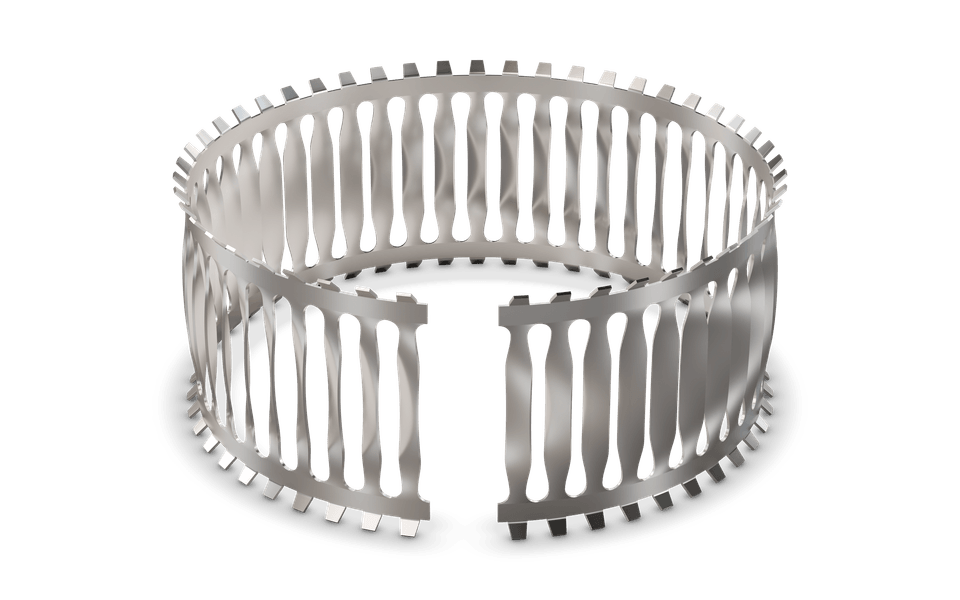
A torsion spring contact band is a lamella contact in which the contact force comes from twisting the webs. The flat spring characteristic gives a large working range, and current takes the shortest path from pin to socket. It is normally used for high currents from 8 mm mating diameter.
-
U
- Undercut groove
- More on this: High-current contact band
An undercut groove is a groove that is wider below its opening than at the opening itself. Its side lips hold an inserted component captive. In flat contacts, the ACA high-current contact band sits in an undercut groove that is milled directly into the conductor or formed by screwed-on cover plates.